
Natural hazards and natural disasters
In November 2013 Typhoon Haiyan, one of the most powerful tropical cyclones on record, with possibly the highest wind speed ever recorded at landfall, swept across South East Asia and struck the Philippines hardest. Photographs from the weeks afterwards show whole neighbourhoods flattened into sheets of corrugated metal, broken timber and blue tarpaulin, with families sitting in the wreckage of their homes. The storm was a natural event. The destruction happened because people were living in its path.
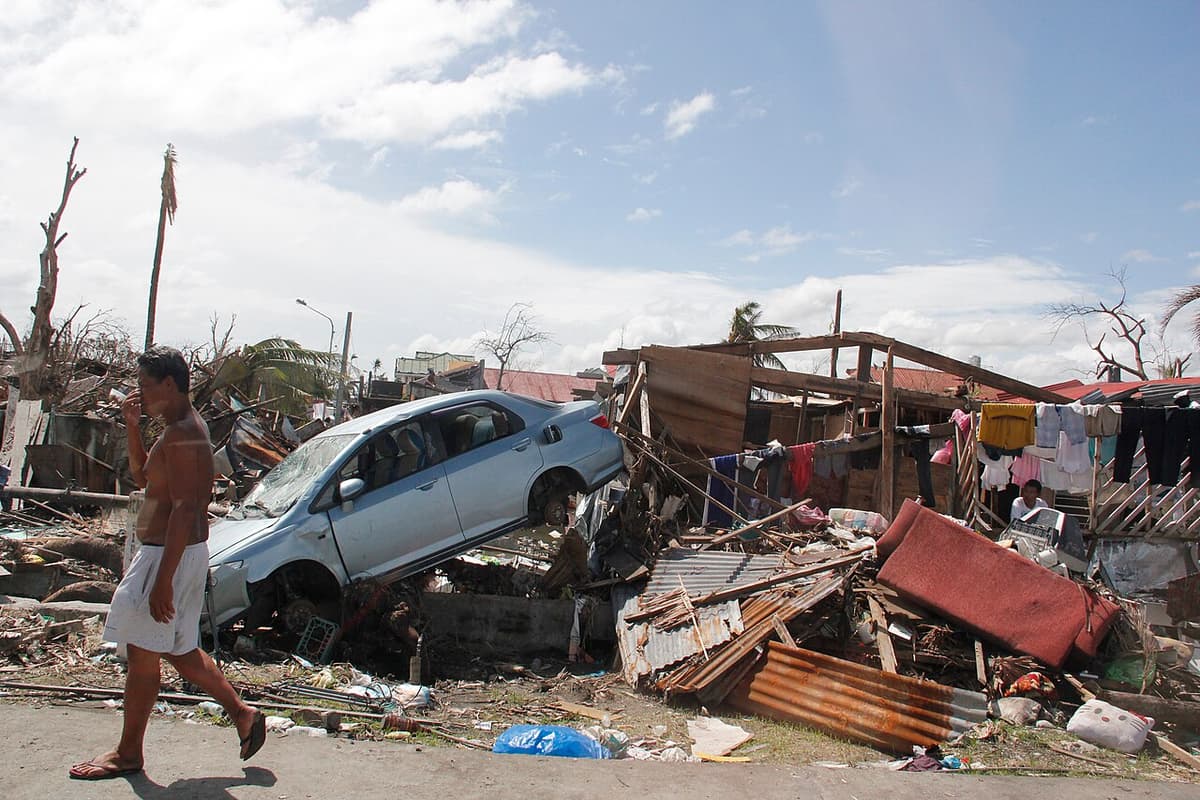
That link between a natural event and the people it reaches is the starting point for studying tectonic activity.
An extreme geophysical process that occurs naturally and could cause loss of life, damage to infrastructure and disruption to human activity.
A process only becomes a hazard because of its possible impact on people. An eruption on an empty island is a natural event. The same eruption beside a city is a hazard. A hazard is therefore defined by the interaction of two systems, the geophysical system and the human system.
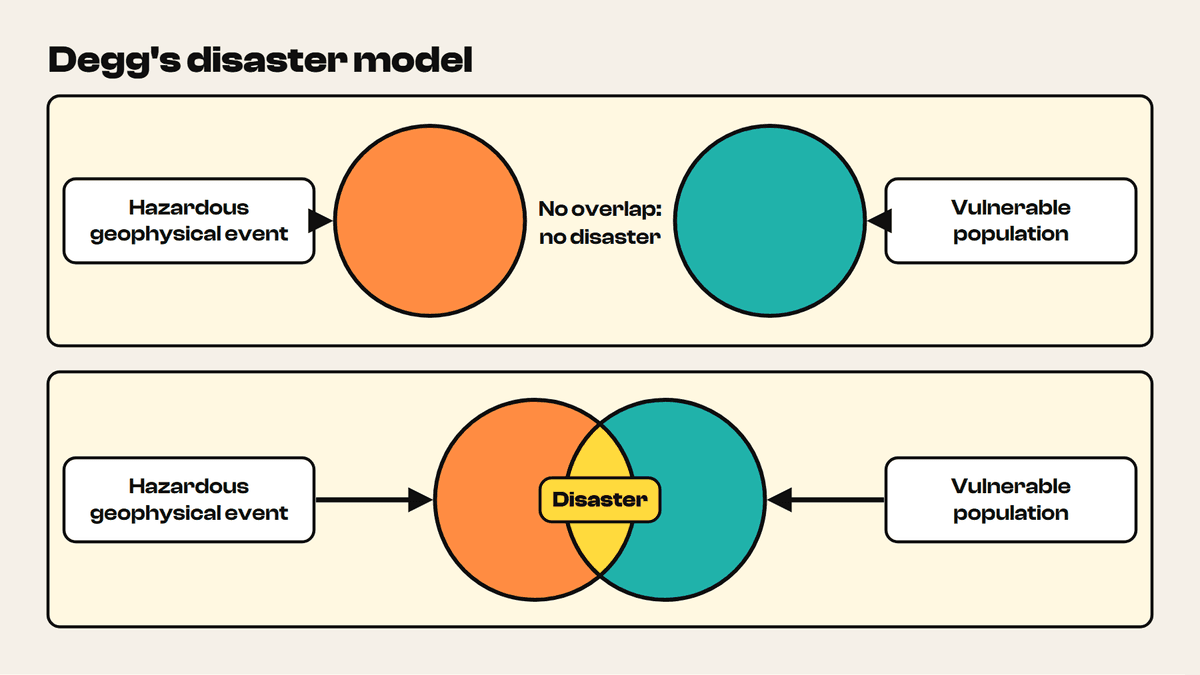
Degg's disaster model shows this with two circles. One represents a hazardous geophysical event, such as a flood or an earthquake. The other represents a vulnerable population. While the circles stay apart there is no hazard and no disaster. When they overlap, the overlap is the disaster. The more extreme the event and the more vulnerable the population, the larger the overlap and the more serious the disaster.
Based on the definition used by the International Federation of Red Cross and Red Crescent Societies (IFRC), a sudden, calamitous event that seriously disrupts a community or society and causes human, material, economic or environmental losses greater than it can cope with using its own resources. Most disasters have natural origins, but some are caused by people.
The important phrase in the IFRC definition is capacity to cope. A flood that one community can manage with its own resources could overwhelm another. Why some populations are more vulnerable than others is explored in the lesson on mitigation.
Human activity also changes how many people are exposed. In many regions, rapid urbanisation (driven by population growth and migration) and the land pressures created by modern farming have pushed more people into places at risk from natural hazards.
Disasters are hard to define precisely, so different organisations use different indicators.
- Money. Insurance companies estimate the monetary losses of an event and set a minimum loss threshold before they pay compensation.
- Scale (space). The UN uses Sustainable Development Goal indicators. A small-scale disaster affects a local community that needs help only from neighbouring communities. A large-scale disaster affects a whole society that needs national or international assistance.
- Time. Usually the most important element. The UN report Terminology on Disaster Risk Reduction (2017) classifies disasters by three timescales.
The UN timescale classes are:
- Frequent or infrequent disasters, depending on how probable the hazard is and its return period, an idea developed in the lesson on prediction. The impacts of frequent disasters can build up over time and become cumulative or chronic.
- Slow-onset disasters, which emerge gradually. Examples are drought, desertification, sea-level rise and epidemic disease.
- Sudden-onset disasters, which are triggered by events that emerge quickly or unexpectedly. Examples are earthquakes, volcanic eruptions, flash floods, chemical explosions, failures of critical infrastructure and transport accidents.
Earthquakes and volcanic eruptions belong in the sudden-onset group. The same list also contains chemical explosions and transport accidents, which shows that the UN classification covers human-caused disasters as well as natural ones.
9 more sections in this topic
Pick this up in your Library: it holds the whole topic, notes, cheatsheet and questions.