
Layers of the atmosphere
A forest in flames, a polar bear stranded on a small raft of sea ice, a satellite image of a giant hurricane. Pictures like these appear in the news whenever climate change is reported. Many scientists argue that today's changes are too large and too fast to come from natural causes alone. To judge that claim, you first need to know how the atmosphere controls Earth's temperature.
The layers of gas surrounding Earth. Together with Earth's surface, the atmosphere regulates the planet's temperature.
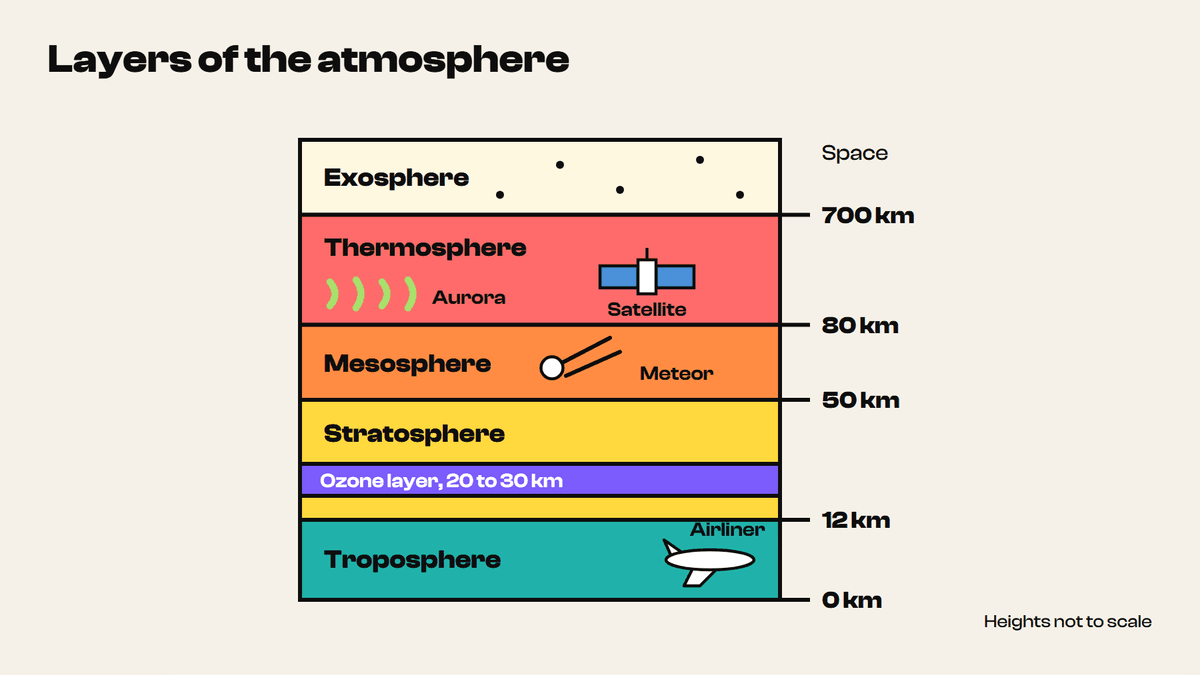
The air gets thinner (less dense) the further you go from Earth's surface. The main layers, from the ground upwards, are listed below.
- Troposphere (0 to 12 km). The densest layer, where clouds and weather form and where airliners cruise.
- Stratosphere (12 to 50 km). Jets can fly here. It contains the ozone layer, at roughly 20 to 30 km.
- Mesosphere (50 to 80 km). Most meteors burn up here.
- Thermosphere (80 to 700 km). Satellites orbit here, and aurorae appear where particles from space collide with gas molecules.
- Exosphere (beyond about 700 km). The thin outer edge where the atmosphere fades into space.
Temperature falls with height through the troposphere, to an average of about -51°C at its top. In the stratosphere it rises with height, because ozone absorbs ultraviolet radiation, and reaches about -15°C where the stratosphere meets the mesosphere.
A zone in the stratosphere with a relatively high concentration of ozone (O3), a form of oxygen. It filters out some of the Sun's high-energy ultraviolet radiation.
The ozone layer matters because short-wavelength radiation carries a lot of energy and can damage living cells. Large doses of ultraviolet light cause sunburn, which is cell damage. Even shorter wavelengths, such as x-rays and gamma rays, can damage DNA and trigger cancerous mutations.
9 more sections in this topic
Pick this up in your Library: it holds the whole topic, notes, cheatsheet and questions.