
Natural resources
Every light switch, phone charger and school bus depends on energy, and almost all of that energy starts with something taken from the Earth. Before comparing ways of making electricity, it helps to know what counts as a resource and which resources can last.
Anything the Earth provides that people can use, from metals and gases to plants, animals and sunlight.
People have relied on natural resources since prehistoric times. Burning wood for a fire and shaping stone into tools are two of the earliest examples. Since then, resource use has risen steadily for two reasons. The world's population has grown, and the technology for extracting resources has become far more advanced.
Natural resources can be sorted in two separate ways. The first sorts them by origin.
A resource that is living or comes from living things, such as plants, animals and fossil fuels.
A resource that comes from non-living things, such as copper and other metals.
Coal, oil and natural gas are often labelled abiotic because they are dug or pumped out of the ground. They are biotic, because they formed from the remains of living organisms millions of years ago.
The second sorts resources by whether they will last.
A resource that can be used again and again without running out, such as wind.
A finite resource. Its supply is limited and will eventually run out, as with coal and oil.
A renewable resource that only stays renewable if people manage it carefully.
The gap between renewable and sustainable matters. Wind keeps blowing whatever people do. A forest or a fish stock can also renew itself, but only if trees are replanted after felling and fish stocks are given time to recover. Overuse can turn a sustainable resource into one that disappears.
| Natural resource | Uses |
|---|---|
| Animals | Food and clothing |
| Plants | Food such as fruit, herbs and vegetables |
| Oil, coal, natural gas | Energy and electricity (non-renewable) |
| Trees | Wood and paper |
| Water | Drinking, and energy (renewable) |
| Metals such as gold, silver and copper | Jewellery and electronics |
Natural resources are used in two broad ways. They are turned into products (copper ends up inside electronic goods) and they are harnessed to produce energy.
Different parts of the world earn money by exporting different resources. Russia, the Middle East, Venezuela and much of north and central Africa mainly export oil. Australia exports metals and minerals, while Greenland, Argentina and New Zealand export food and drink. Other places, such as China and the USA, mainly export electronics, and Canada, Brazil and much of Europe export machinery and transport goods. These are manufactured rather than taken straight from the ground, so not every economy rests on raw natural resources.
Human and economic resources
Some of the most important resources do not come from the ground at all. They come from people and from the way a society organises production.
The workforce and the range of skills people use to carry out different jobs.
A factory cannot run without workers. A plane needs a well-trained pilot, a surgeon needs years of skill to operate, and farms depend on people to grow and harvest food. This workforce is called labour.
The resources used to produce goods: land, labour, capital and technology.
Labour is both a human resource and an economic resource. Land, capital (the money and equipment invested in production) and technology complete the set. Together they work as a simple system.
- Inputs are the land, labour, capital and technology.
- Processes are what happens to those inputs, such as farming, building or manufacturing.
- Outputs are the finished results, such as food, buildings and computers.
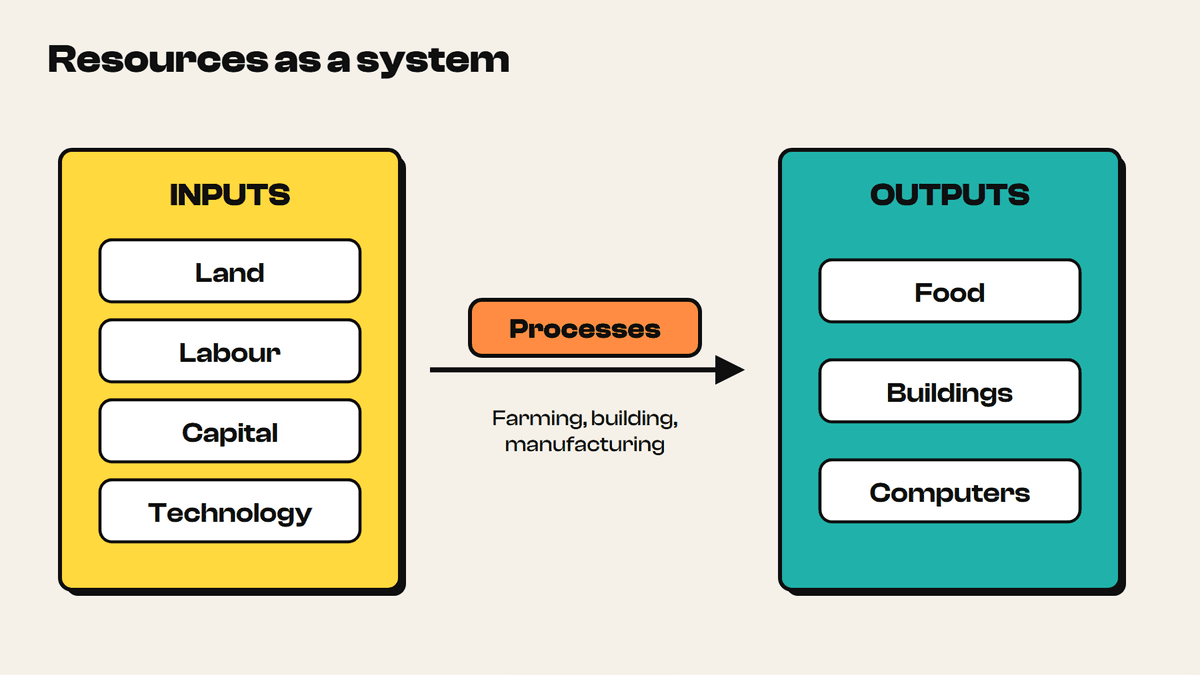
A power station fits the same pattern. It needs land to stand on, capital to pay for construction, technology such as turbines and generators, and labour in the form of engineers and operators.
The output is electricity. Every energy source in the rest of the topic depends on human and economic resources as well as natural ones.
9 more sections in this topic
Pick this up in your Library: it holds the whole topic, notes, cheatsheet and questions.