
Individuals or impersonal forces
Wars are often told as stories about leaders. Hitler invaded Poland, Germany under Wilhelm II handed Austria-Hungary the Blank Cheque, and Japan attacked Pearl Harbor while General Tojo was prime minister. Each of these leaders, though, acted inside conditions they had not created, such as a peace settlement many people thought unfair, a world economic depression and a desperate shortage of oil. Historians therefore argue about how much weight to give to the decisions of individuals and how much to the larger forces that shaped those decisions.
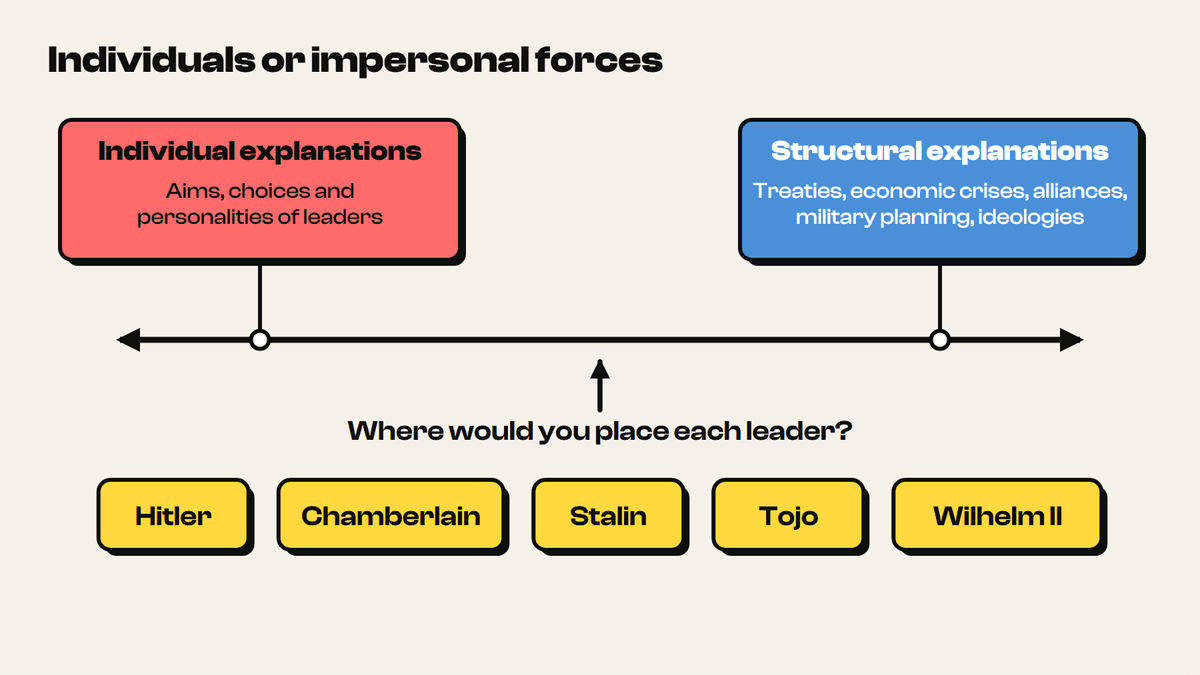
An account of a war that places the main responsibility on the aims, choices and personalities of particular leaders.
An account that stresses impersonal forces, such as treaties, economic crises, alliances, military planning and ideologies, which push states towards conflict whoever happens to lead them.
The two kinds of explanation are rarely complete opposites. Leaders respond to pressures, and pressures only turn into war when someone decides to act. A useful test of a leader's importance is a counterfactual one. Ask whether war would still have broken out at roughly the same time if that person had not been in power. If war still looks likely, structures carry more of the weight. If war looks unlikely without that leader's choices, the individual matters more.
Structural forces at work in the 1930s included the Treaty of Versailles, which many in Britain saw as too harsh on Germany, the Depression, which left Britain and France economically weak, the isolationist foreign policy of the USA, and Japan's dependence on the USA for 80 per cent of its oil.
None of these was one person's decision, yet all of them shaped what leaders felt able to do.
8 more sections in this topic
Pick this up in your Library: it holds the whole topic, notes, cheatsheet and questions.