
Earth's atmosphere
News reports often claim that today's climate is changing too much and too fast for natural causes alone to explain. Testing that claim needs two things. First, a working model of how Earth keeps its temperature steady. Second, evidence that can separate natural causes from human ones. The model starts with the atmosphere, the envelope of gases that interacts with Earth's land and oceans to regulate temperature.
Before reading on, write down 3 thoughts about what causes climate change, 2 questions you would like answered and 1 analogy the causes remind you of. Keep the list. You will redo it at the end and compare.
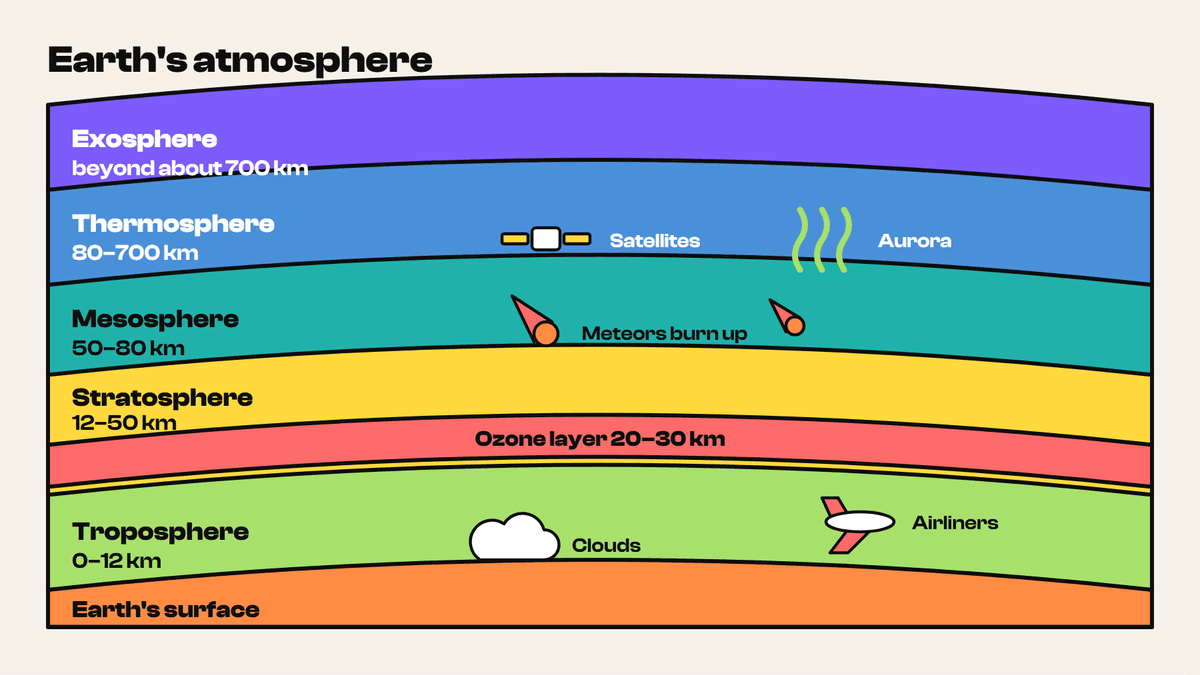
The atmosphere gets thinner (less dense) with distance from the surface. Scientists divide it into layers.
- Troposphere (0–12 km). The lowest and densest layer. Clouds and weather form here.
- Stratosphere (12–50 km). Above the weather. Aircraft cruise in the upper troposphere and into the stratosphere.
- Ozone layer (20–30 km). A band within the stratosphere that is relatively rich in ozone.
- Mesosphere (50–80 km). Most meteors burn up here.
- Thermosphere (80–700 km). Satellites orbit at this height, and the Karman line lies within it at 100 km. Aurorae form here when charged particles from the Sun (the solar wind) collide with gas molecules.
- Exosphere (beyond about 700 km). The thin outer fringe, stretching far into space.
A form of oxygen molecule made of three oxygen atoms. In the ozone layer it filters out some of the Sun's high-energy shortwave ultraviolet radiation.
Together the troposphere and stratosphere reach about 50 km up. Temperature falls with height through the troposphere, then rises again through the stratosphere, because the ozone layer absorbs ultraviolet radiation and turns it into heat. It falls once more through the mesosphere, and the coldest air, about -90°C, lies near the top of the mesosphere. For climate, these two lowest layers matter most, because they hold the densest air and the ozone layer.
9 more sections in this topic
Pick this up in your Library: it holds the whole topic, notes, cheatsheet and questions.