
Origins of exchange
A cartoon titled World Trade Rules, OK? shows a huge figure taking over a market stall while smaller, poorer figures look on. One of them is labelled LDC (less developed country). The cartoonist's point is that the rules of world trade favour whoever is already powerful. Whether trade or aid better helps poorer countries develop is a central debate in development.
Exchange between people is very old. The traditional view is that societies without money relied on barter.
Swapping goods directly for other goods or services, with no money involved.
Barter only works when each side happens to own something the other wants. The anthropologist David Graeber, in Debt: The First 5,000 Years (2011), argued that simple barter is too tidy an explanation, because it would not have let small groups obtain everything they needed to survive. He suggested early societies behaved more collectively, with everyone contributing to a shared store kept for the whole group. Marx called this kind of arrangement 'primitive communism'.
As societies grew, they needed more sophisticated ways to trade, both internally and with outsiders. The breakthrough was realising that a promise of value could replace the object itself. The ancient Sumerians recorded quantities of stored goods on clay tablets, and the tablets could be traded. Anyone who accepted a tablet as payment, up to the value written on it, was using it as a go-between in trade. That makes it the first money. Coins, such as those stamped with the head of Alexander the Great, and later notes, cheques and debit and credit cards, all work on the same principle. People want money for what it can be exchanged for. The metal, paper or plastic matters very little.
Trade between states also left early records. The Amarna letters of the 14th century BCE are clay tablets of correspondence between Ancient Egypt and diplomats in Canaan and Amurru. They are written in Akkadian, an internationally recognised language of the time, and among their topics are trade restrictions between the territories. Arguments about limiting trade are more than 3,000 years old.
Petra and the incense trade. The Nabataeans lived at Petra, in what is now Jordan, on a route carrying incense from southern Arabia to Gaza, Jerusalem and Damascus.
Incense was a valuable commodity with religious and cultural uses. The rocky terrain was very hard to navigate, and the Nabataeans' unrivalled knowledge of it gave them an advantage that grew into a monopoly.
The wealth paid for cities, monuments carved into the rock and rainwater harvesting.
Harvesting rain improved farming in a dry desert climate and allowed the population, and its cities, to grow. Control of a trade route turned local geography into national wealth.


Trade also shapes relations between countries. Rising trade often supports peace, and European economic integration after the Second World War is widely seen as a lasting remedy for the conflicts of the early 20th century.
Pattern of world trade
International trade happens when one country sells commodities, goods or services to another. Countries tend to export what they can produce easily and in bulk, usually because of geographical advantages and plentiful natural resources. Every export is also somebody else's import, which is why trade is best measured as a balance.
The value of a country's exports minus the value of its imports.
When exports are worth more than imports the country has a trade surplus, which tends to bring rising wealth. When imports are worth more, it has a trade deficit.
A negative balance of trade, where a country spends more on imports than it earns from exports. Over time it can lead to debt and falling wealth.
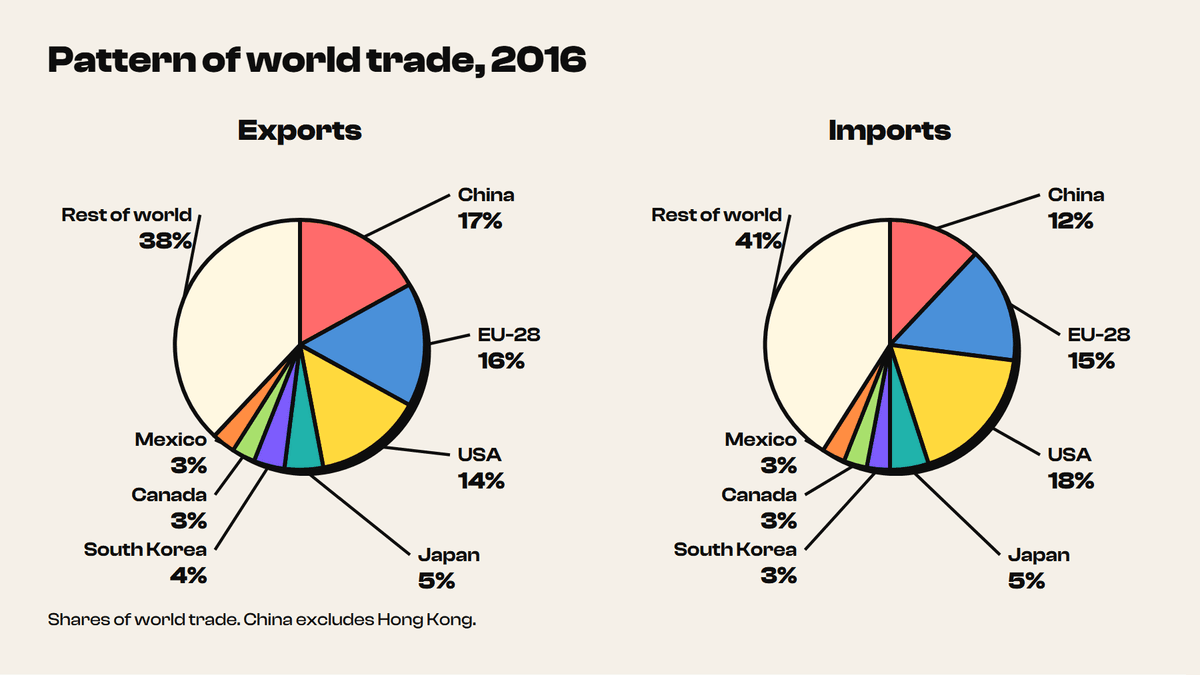
A small group of economies dominates world trade. In 2016:
- Exports: China (excluding Hong Kong) 17%, the EU-28 16%, the USA 14%, Japan 5%, South Korea 4%, Canada 3%, Mexico 3%. The rest of the world together supplied 38%.
- Imports: the USA 18%, the EU-28 15%, China 12%, Japan 5%, South Korea 3%, Canada 3%, Mexico 3%. The rest of the world took 41%.
Comparing the two charts hints at trade balances. China's share of world exports is bigger than its share of imports, which points to a surplus. The USA's import share is bigger than its export share, which points to a deficit.
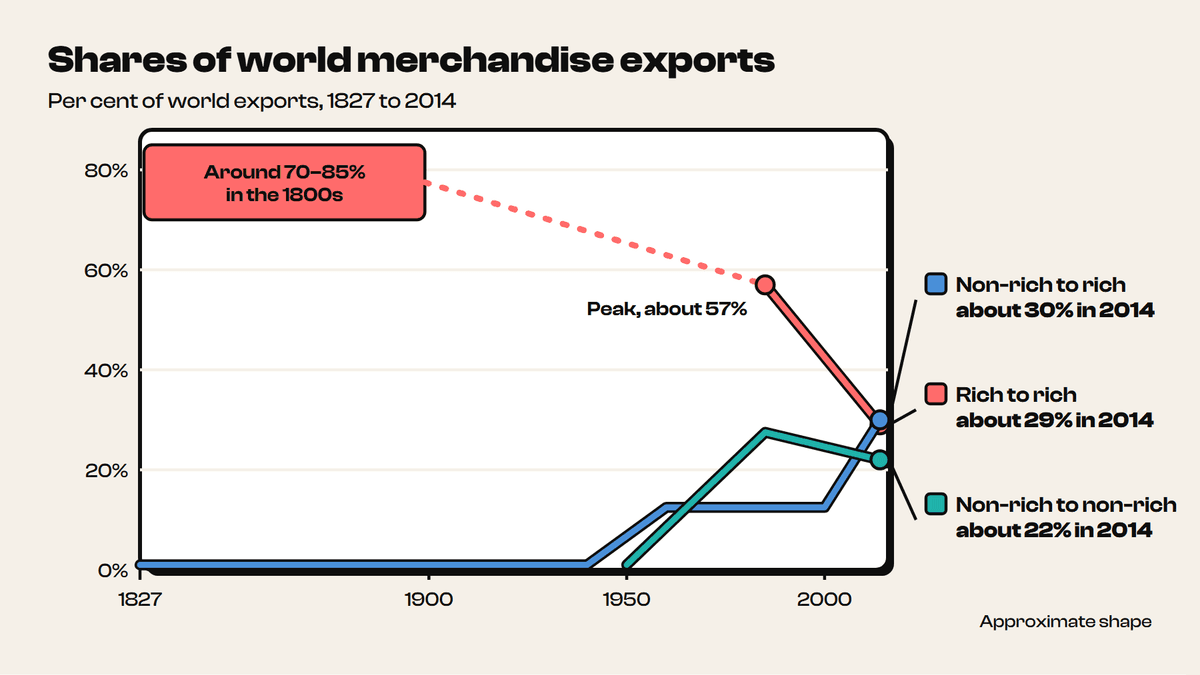
For most of modern history, world trade fitted a North-South divide. Richer countries and their multinational corporations traded mainly with each other and held most of the advantages. Figure 7.12 tracks shares of world merchandise exports from 1827 to 2014 and shows that pattern weakening:
- Rich-to-rich trade made up around 70–85% in the 1800s. After falling and recovering, it peaked at about 57% around 1985, then dropped to about 29% by 2014.
- Non-rich to rich trade stayed close to zero until around 1940 and at 10–15% until 2000. It then rose steeply to about 30% by 2014, meeting the rich-to-rich line.
- Non-rich to non-rich trade (often called South-South trade) grew from almost nothing to around 25–30% after 1950 and stood at about 22% in 2014.
Two things drove the recent shift. Advances in transport and communication made long-distance trade cheaper, and more preferential trade agreements were signed between developing countries. Total world trade also grew strongly over this period, as the lesson on globalization's economic impacts shows.
Figure 7.12 shows shares, not values. Because total world trade grew so much, a falling share for rich-to-rich trade does not by itself mean rich countries traded less. It means trade involving poorer countries grew faster.
11 more sections in this topic
Pick this up in your Library: it holds the whole topic, notes, cheatsheet and questions.