
Multinational and transnational corporations
Try listing ten large companies whose products you used this week. The phone in your pocket, the shampoo in your bathroom, the fuel in the bus and the breakfast cereal on the table were very probably made, moved or sold by a company that works in many countries at once. These firms shape where factories are built, who gets the jobs and which places grow or decline. That makes them central to how economies develop.
An international company with its headquarters in one country that invests in and operates in several other countries, adapting its products and services to suit each local market.
The country where a multinational has its headquarters.
A country where a multinational runs operations such as factories, offices or shops, away from its headquarters.
An international company organized much like an MNC, but whose headquarters are usually tied to research and development (R&D) centres, and whose operations in host countries are controlled far more directly from the home country.
The difference is mostly about control. An MNC gives its overseas branches room to fit in with local tastes. A TNC runs its global operations more tightly from the centre, where the new ideas and designs are produced. In everyday speech the two terms are often swapped, so look at how a company is actually run before deciding which label fits.
Adapting to local markets often includes changing the brand name. The skincare brand Olay keeps the same logo, a gold circle with a stylized face, but has been sold under different names in different regions.
Customers in each host country meet a version of the brand that feels familiar to them.

Multinationals are only one kind of firm. An economy contains a mix of businesses that trade and cooperate with one another.
- State-owned enterprises belong to the public sector and are run by the government.
- National firms are privately owned and based in one country. Small ones usually have a single plant. Large ones usually run several plants.
- Transnational corporations range from smaller TNCs to giant global corporations.
These firms are linked in several ways. Some deals are simple 'arm's-length' purchases between independent firms. Others are closer: subcontracting (one firm pays another to do part of the work), licensing (allowing another firm to use a product, design or brand), strategic alliances between firms, and joint ventures or industrial cooperation agreements, which often link state-owned enterprises with TNCs.
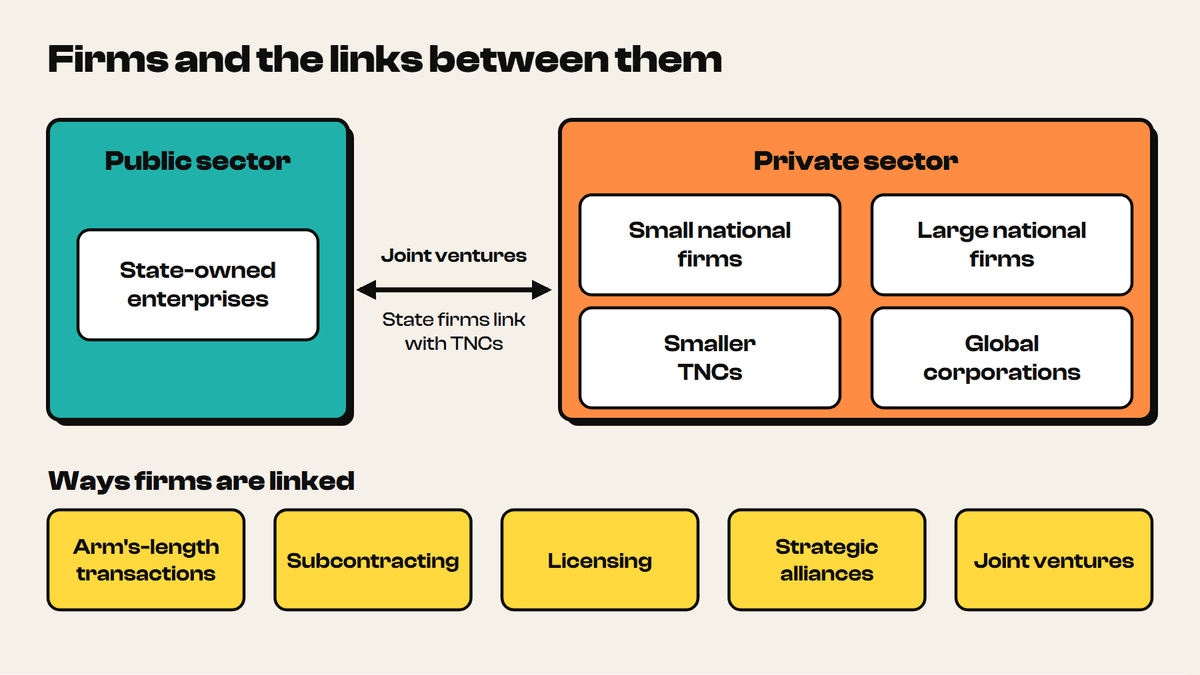
Large international firms are not all in the private sector. State-owned enterprises belong to the public sector, yet they can still link with TNCs through joint ventures, licensing and subcontracting. Check who owns a firm before classifying it.
9 more sections in this topic
Pick this up in your Library: it holds the whole topic, notes, cheatsheet and questions.