
The Age of Reason
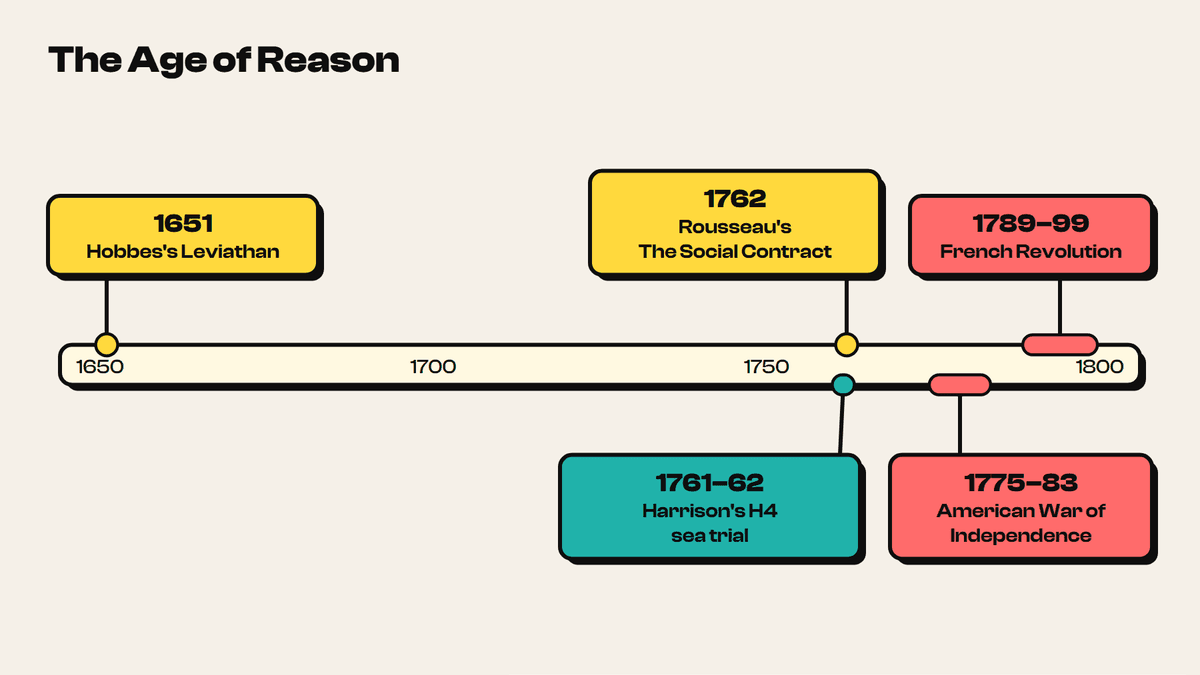
The Enlightenment is the name historians give to a period in Europe and America that began in the mid-17th century and lasted through the whole of the 18th century. Science, philosophy, politics and mathematics all changed during these years. That is why the period holds such an important place in the history of ideas. Accurate navigation at sea, vaccines, and the belief that governments should respect people's rights all trace back to it.
Reaching decisions through logical thinking, by applying rational methods to a problem instead of relying on habit, tradition or the word of an authority.
Enlightenment thinkers placed so much trust in reason that the period is also called the Age of Reason. In practice, reasoning involved a set of habits:
- observing carefully what actually happens
- questioning accepted explanations, even ones backed by powerful people
- testing an idea to see whether it holds up
- applying the result to a real problem
This questioning spirit had been building for some time, partly inspired by Renaissance humanism. The earlier breakthroughs in astronomy and the rise of the scientific method belong to the lesson on the Scientific Revolution. During the Enlightenment, reason was turned onto two areas of everyday life. The first was practical problems such as disease, navigation and electricity. The second was the question of who should hold power and what rights ordinary people have.
Electricity and encyclopedias
Harnessing electricity is arguably one of the greatest innovations in human history. It did not happen all at once. Understanding grew in stages, and Enlightenment scientists laid some of the first foundations.
The scientist Otto von Guericke built an electrostatic generator, a machine that could produce electricity. Later the American scientist Benjamin Franklin took the work further. He studied how electricity could be stored, linking Leyden jars together into what he called an "electrical battery" (1749). Charles du Fay had already identified two kinds of electrical charge in 1733, and Franklin gave them the names positive and negative. Using electricity to light and power homes came much later, but it depended on this early work.
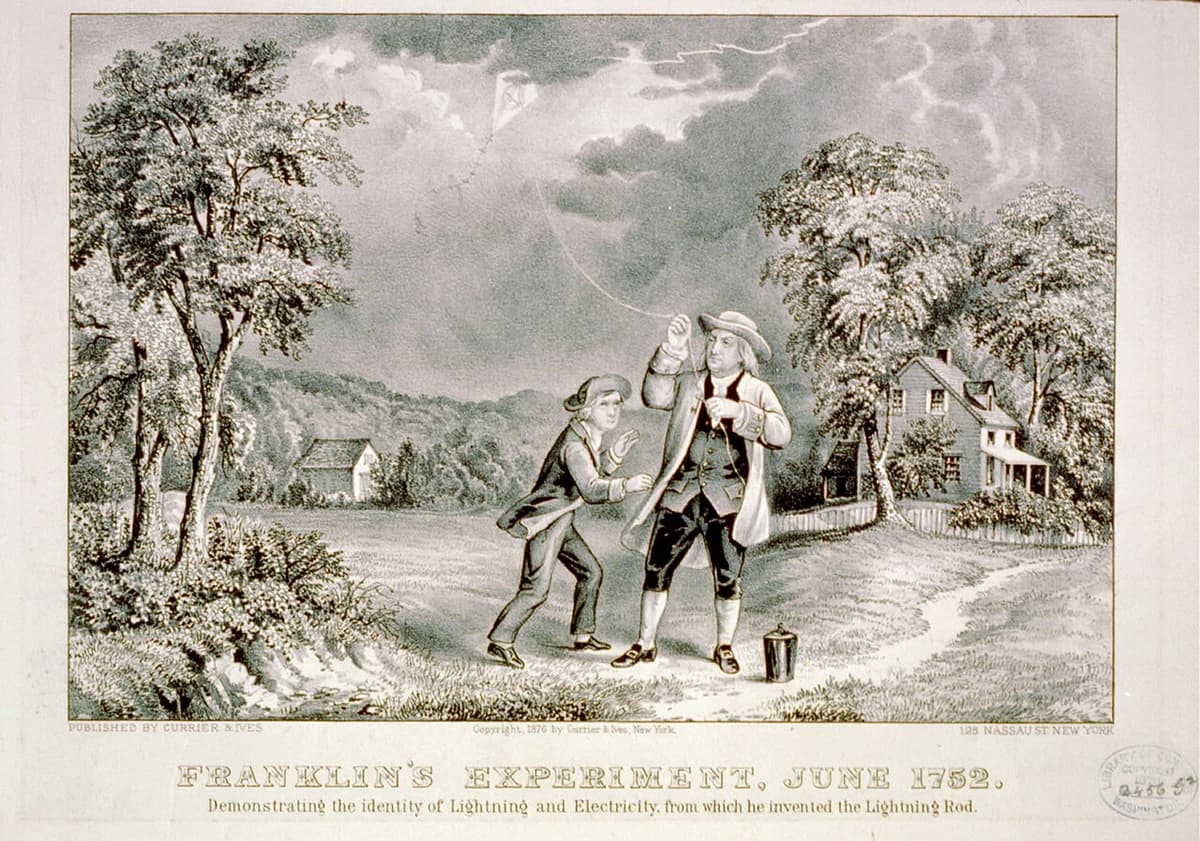
Franklin's most famous experiment shows the Age of Reason at work. Lightning was frightening and poorly understood. Franklin suspected it might be the same thing as the electricity produced in experiments, so he designed a way to test the idea.
Franklin's kite experiment followed clear steps.
- Idea: lightning may be a form of electricity.
- Test: fly a kite in a thunderstorm with a metal key tied to the string.
- Observation: electric charge from the storm cloud travelled down the wet string to the key, which gave off sparks.
- Conclusion: lightning is electricity.
A mysterious natural event became something that could be explained and studied.
A discovery changes little if only a handful of people know about it. During the Enlightenment, scientific knowledge began to be collected in encyclopedias, large reference works that gathered information in one place for a wide audience. As new ideas appeared, people outside universities and scientific societies could read about them and understand them. Encyclopedias are still popular today for the same reason. They show that sharing knowledge was itself an innovation, because it allowed discoveries like Franklin's to spread and be built upon.
9 more sections in this topic
Pick this up in your Library: it holds the whole topic, notes, cheatsheet and questions.