
Vijayanagara and Hampi
When the Portuguese traveller Domingo Paes looked across Vijayanagara from a hill in the sixteenth century, he could not take in the whole city from one spot. He judged it "as large as Rome" and noticed groves of trees, water channels running into the city and lakes between the hills. Within a few decades of his visit the city had been sacked and abandoned.
"City of victory". The name of both an imperial capital and the empire it ruled, set up in south India in the fourteenth century.
At its height the empire stretched from the river Krishna in the north to the southern tip of the peninsula. Historians call it the Vijayanagara Empire, but its own people used a different name.
The name people of the time gave to the empire that historians now call Vijayanagara.
After 1565 the city decayed into ruins over the seventeenth and eighteenth centuries. People in the Krishna-Tungabhadra doab still remembered it, calling it Hampi after Pampadevi, the local mother goddess.
The ruins came back to scholarly attention in 1800, when Colin Mackenzie, an engineer and antiquarian working for the English East India Company, drew the first survey map of the site. Much of his early information came from the memories of priests at the Virupaksha temple and the Pampadevi shrine. Mackenzie became the first Surveyor General of India in 1815, and he was open about his motives. He believed that studying Vijayanagara would give the Company useful knowledge of the laws and customs of the people it governed, so his survey served colonial rule as well as scholarship.
Others followed. Epigraphists began collecting inscriptions from Hampi's temples from 1836, and photographers began recording the monuments in 1856, when Alexander Greenlaw took the first detailed photographs. Historians then checked these finds against foreign travellers' accounts and against literature in Telugu, Kannada, Tamil and Sanskrit.
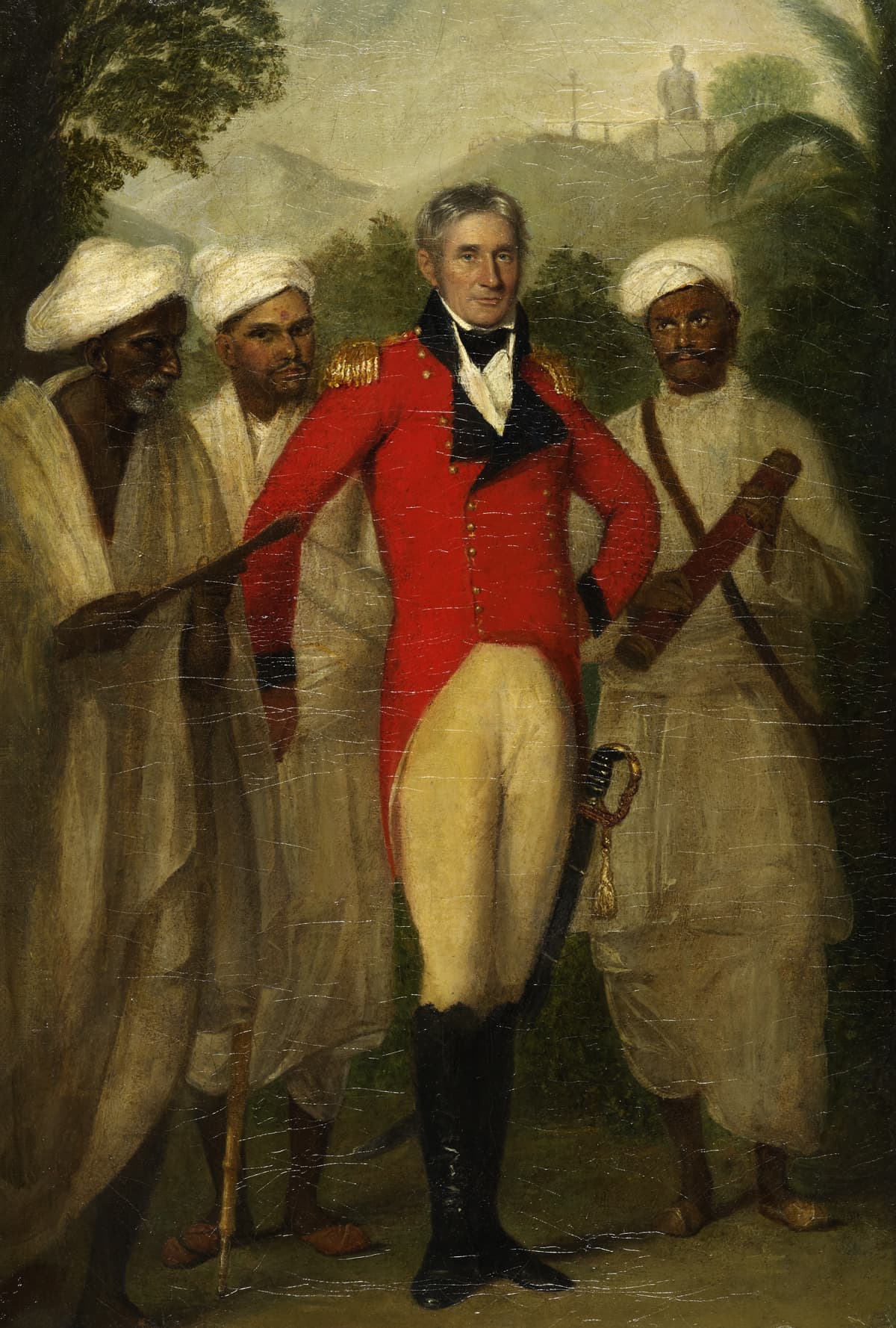
The painting of Mackenzie shows him large and central, with the Indian scholars who supplied much of his knowledge placed around and behind him. Consider what that arrangement suggests about whose knowledge the artist chose to credit.
9 more sections in this topic
Pick this up in your Library: it holds the whole topic, notes, cheatsheet and questions.