
Laissez-faire and the cholera challenge
A modern public health poster headed CHOLERA ALERT uses seven pictograms: safe drinking water, handwashing, eating, a crossed-out (prohibited) action, using a toilet, washing produce and visiting a clinic. It also tells people to wash their hands with soap or ash under running water. Look closely and you will see that most of these depend on things no single family can build for itself: piped clean water, sewers, toilets and clinics. Protecting a whole community from disease needs organisation on a large scale. That is why the story of public health is also a story about what governments are willing to do.
A French phrase meaning 'leave alone'. A laissez-faire government believes it should not interfere in people's private lives or in the economy, so health, housing and working conditions are left to individuals and employers.
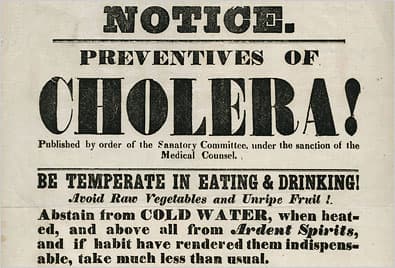
In 1800 the British government took a laissez-faire view of public health. It did not see the health of ordinary people as its job. Over the nineteenth century that view came under pressure from three directions.
- Industrialisation and urbanisation. Huge industrial cities grew very fast. Workers crowded into poor housing with no sanitation and no clean water.
- Population growth. More people packed into the same streets meant disease spread faster.
- New ideas and medical theories. Doctors and reformers began to show why people in cities were dying, which made it harder to argue that nothing could be done.
Cholera made the problem impossible to ignore. Without proper sewers or clean water, British cities suffered severe cholera epidemics. In 1854 the London doctor John Snow traced a cholera outbreak to a single water pump and proved that the spread of cholera was linked to polluted water supplies. This was a turning point for the argument about government. If the killer travelled through the water supply, then a family could be careful and still die, because the danger came from a shared system. Only a public authority could replace that system with sewers and clean water.
The evidence reformers collected about life in industrial towns, including Chadwick's 1842 report, belongs to the lesson on the Industrial Revolution.
Laissez-faire did not mean Parliament passed no laws about towns at all. Between 1700 and 1840 it authorised more than 600 Acts for improvement schemes in individual British towns.
What was missing was a national acceptance that government was responsible for the health of the whole population.
9 more sections in this topic
Pick this up in your Library: it holds the whole topic, notes, cheatsheet and questions.