
State and government
Suppose the streetlamp on your road stops working. Someone has to fix it, and knowing whom to ask depends on knowing how government is arranged. India is governed in layers, and each layer has its own jobs. The starting point is two words that people often use as if they meant the same thing.
A political organisation with the authority to govern a clearly marked territory and the people living in it. In India the word can also mean a unit such as Kerala or Tamil Nadu.
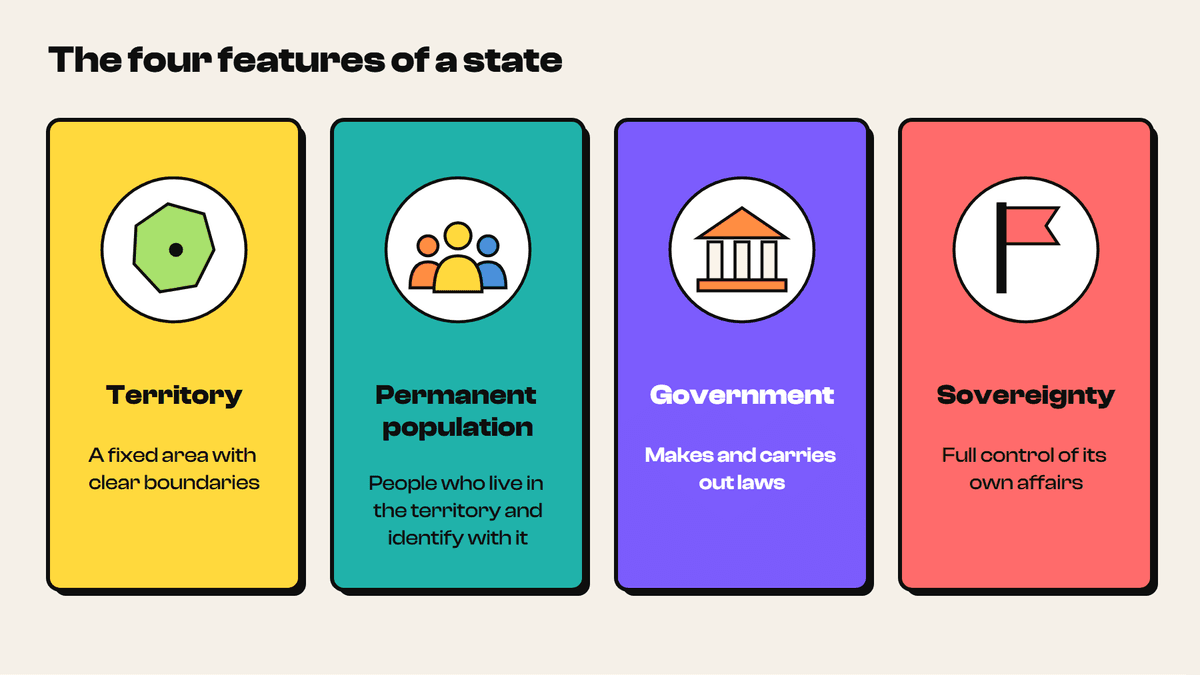
Every state has four features.
- Territory, a fixed area with clear boundaries. The boundaries do not have to follow rivers or mountains. They can be lines that neighbouring states have agreed on.
- Permanent population, people who live in the territory and identify with it. Visitors who pass through and leave, like tourists, do not count, because they share no common life there. A settled population builds a culture and a society tied to its land.
- Government, because people living together need laws made and carried out, and that is the government's work.
- Sovereignty, the state's full control of its own affairs. It makes and enforces laws to suit its own needs, and no other state or outside body can interfere in its internal matters.
The group of people, or the system, that runs the country. It is made up of leaders, ministers and officials who make laws, enforce them and settle disputes.
The government is one of the four features, so it is part of the state but not the whole of it. Governments change after elections. The state carries on.
Think of a school. Principals and teachers come and go over the years, yet the school itself remains. The state is the school, and the government is its current staff.
The two words get mixed up for two reasons. The government does the state's daily work, so it is the part of the state people actually see. And when people need something, they deal with the government, almost never with the state as a whole. So people say "the state did this" and "the government decided that" about the very same action.
Legitimate power and the three organs
Thinkers in ancient India already saw why a state needs power. They described matsya nyaya, the law of the fishes, in which the big fish swallow the small ones wherever there is no law and order. Kautilya, author of the Arthashastra, argued that the king, as the state's highest authority, had to follow Raja Dharma. That meant governing well and keeping law and order, so that society did not slide into chaos with the strong preying on the weak.
The power the state claims the right to use, for example through policing and taxation. It is exercised through the state's institutions.
The police show this power at work. In India they keep law and order within each state and belong to the state government, working directly with communities in villages, towns and cities. The law allows them to use force so that people can live safely, free from crime and violence. They work alongside the courts, prisons and the rest of the criminal justice system, and they also run awareness drives on road safety, drug abuse and women's safety. Their power has limits. They are bound to respect and protect the rights the Constitution guarantees.
The state's power is divided among three organs of government.
- The legislature makes laws.
- The executive carries out laws and makes policy.
- The judiciary makes sure laws are obeyed and settles disputes.
A set of ideas or actions that a government or other institution decides to adopt.
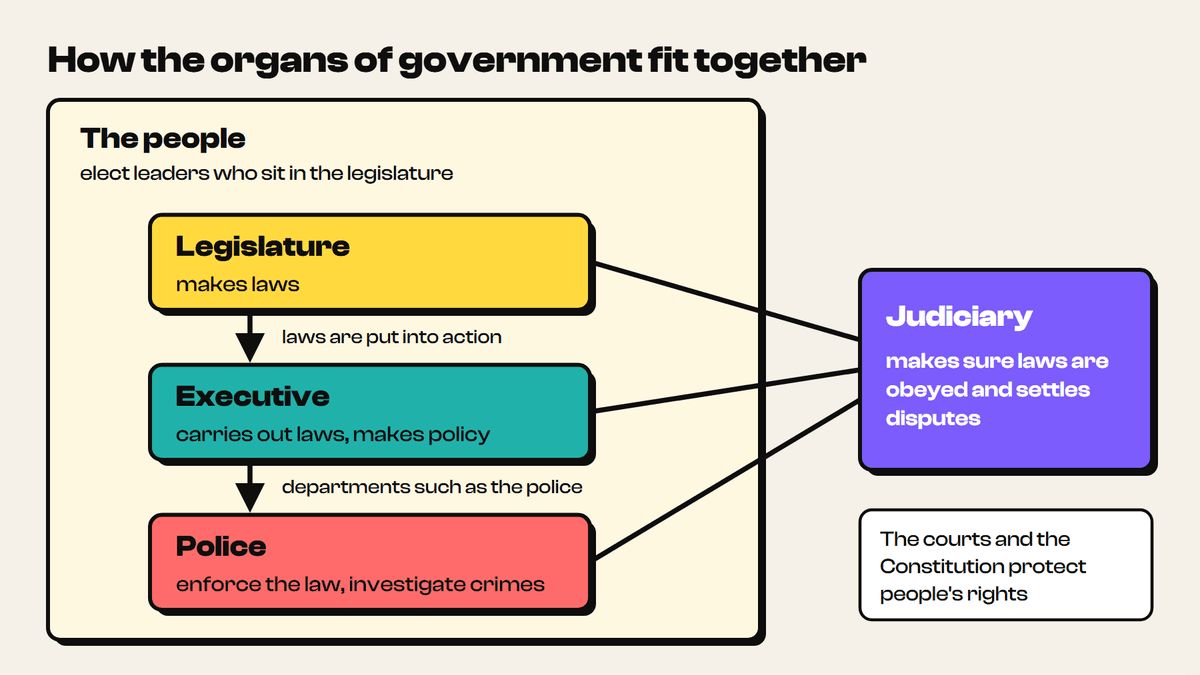
The people elect leaders who sit in the legislature. The executive, which includes departments such as the police, puts laws into action. The police enforce the law, investigate crimes and present cases to the courts, while the courts and the Constitution protect people's rights. Most of the time, when ordinary people deal with the government, they are dealing with one of the executive's departments.
9 more sections in this topic
Pick this up in your Library: it holds the whole topic, notes, cheatsheet and questions.