
Pathogens and how they spread
Picture a flu outbreak at school. Several classmates are absent, and a few who came in anyway are coughing and sneezing in a crowded room. Within a week more seats are empty. Stopping that chain happens at every level, from one student washing their hands, to a national government passing laws, to world bodies sounding a global alarm.
The World Health Organization (WHO) describes health as complete physical, mental and social well-being. Being free of disease is only one part of it.
A disease is any condition that upsets the normal working of the body or mind, often because an organ or organ system stops working properly. Poor nutrition or an unhealthy lifestyle causes some diseases. Many others are caused by germs.
An organism that causes disease. Pathogens include bacteria, viruses, fungi, worms and protozoa (single-celled organisms).
The two main types of disease differ in a way that matters for crisis management, because only one type can move through a population.
- Communicable diseases are caused by pathogens and pass from one person to another. Typhoid, dengue, flu, chickenpox and COVID-19 are examples.
- Non-communicable diseases, such as cancer, diabetes and asthma, are not caused by pathogens and cannot be caught from someone else. They are usually linked to lifestyle, diet or environment.
Every communicable disease begins with a pathogen getting into a new body, and Fig. 3.4 groups the usual ways in.
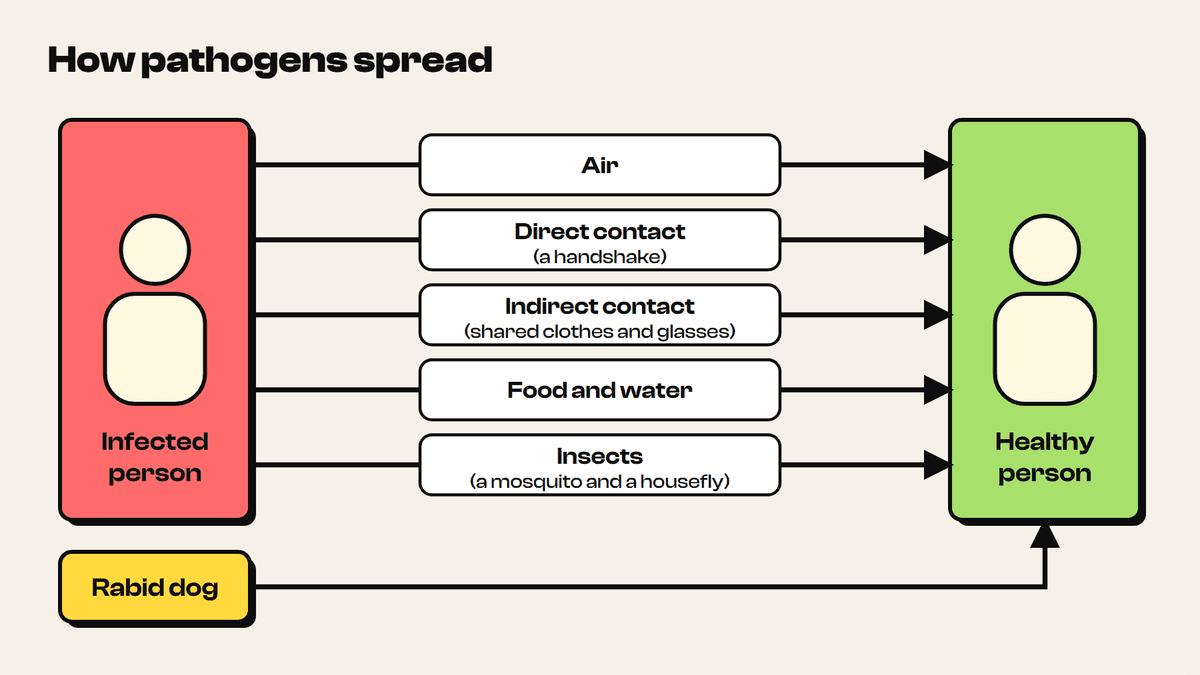
- Through the air, when an infected person coughs or sneezes and others breathe the pathogen in. Common cold, influenza, chickenpox, measles and tuberculosis (TB) spread this way.
- By direct contact, such as shaking hands with someone who is infected.
- By indirect contact, through sharing an infected person's belongings, such as clothing, glasses or towels.
- Through contaminated food and water. Hepatitis A, cholera, typhoid and roundworm infection (ascariasis) travel by this route.
- Through insect carriers. Malaria, caused by protozoa, and dengue, caused by a virus, are both carried by mosquitoes.
An insect, such as a mosquito or a housefly, that carries a pathogen to people.
9 more sections in this topic
Pick this up in your Library: it holds the whole topic, notes, cheatsheet and questions.