
Biomes and where they are found
Picture a family of brown bears strolling down a dirt road while a queue of pickup trucks waits behind them. Then picture rippled sand dunes stretching to the horizon, with a single line of footprints along a ridge. These two scenes come from very different natural environments, and each one shapes what life is like there. The environment decides which plants and animals can survive in a place, and it also decides how people must adapt or change their way of life. Life in Canada's far north is very different from life on a tropical island.
Geographers think of each environment as a system. The key concepts are systems, sustainability, and identities and relationships.
The big idea that guides the inquiry. Here it is that the relationships among living things in various environments may be understood as a system, and that sustainability can help those environments endure into the future.
The inquiry is driven by three kinds of question.
- Factual: What are biomes and where are they located? How does climate shape a biome's make-up? How is climate shown on a graph? How is climate change affecting the world's natural environments?
- Conceptual: How do different environments function as systems? What impact have humans had on environments? How can sustainability help environments?
- Debatable: Should humans protect natural environments at all costs?
There are three learning goals. The first is to find out about different world environments and how they can be seen as a system. The second is to explore examples of human impact on environments, through case studies of grassland and rainforest biomes. The third is to take action by promoting sustainable development in local and global contexts.
How living things depend on each other through producers, consumers and food webs is covered in the lesson on forests, grasslands and tundra.
A very large area of the world where the vegetation, climate and animal life are similar.
Biomes can be grouped in different ways. One simple split is between land and water.
A land-based biome, such as a desert, grassland, forest or mountain area.
A water-based biome, found in seas, oceans, lakes, rivers or wetlands.
The same type of biome can turn up in several parts of the world. Deserts, for example, are found in Africa, Asia, Oceania and North America. Knowing a place's biome tells you a lot at once: its climate, its plants and animals, and how living things have adapted to the conditions there.
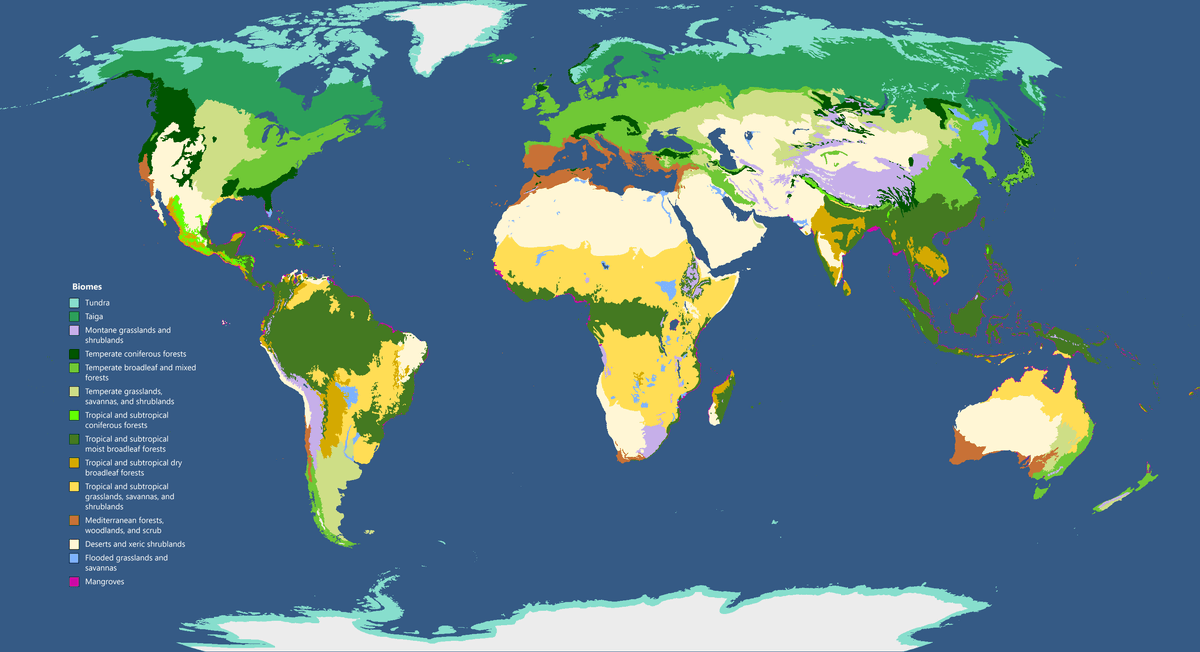
The world biome map shows clear patterns.
- Rainforest sits around the equator, in the Amazon, central Africa and Southeast Asia.
- Savannah surrounds the rainforests in Africa, South America and northern Australia.
- Desert covers North Africa, the Middle East, central Asia, inland Australia and parts of south-west North America.
- Temperate forest covers the eastern USA, Europe and eastern China.
- Grassland appears in central North America, central Asia and Argentina.
- Taiga forest forms a wide band across Canada and Russia.
- Tundra lines the far north, in northern Canada, Alaska and northern Russia.
When you read a biome map, look for bands. Many biomes stretch east to west across a continent, and the same colour often repeats at a similar distance from the equator. That repetition is a clue that latitude, and so climate, is at work.
9 more sections in this topic
Pick this up in your Library: it holds the whole topic, notes, cheatsheet and questions.