
Kingdoms and empires
The Arthashastra, a text traditionally said to hold the ideas of Kautilya, the adviser behind one of India's greatest empires, puts it simply. There is no kingdom without a country, and no country without its people. Rulers in ancient India spent centuries working out how to bring many kingdoms, and many peoples, under one authority, and how to keep them there.
The word empire comes from the Latin imperium, meaning supreme power.
A group of smaller kingdoms or territories under the authority of one powerful ruler (or group of rulers), often brought together by war and governed from a capital that is usually a major centre of trade and government.
A ruler or state that has submitted to an emperor and pays tribute (gold, grain, cattle, elephants or other valuable goods) as a sign of loyalty. Another word for a tributary is a vassal.
The big difference from a kingdom is the extra layer on top. A kingdom has one ruler over one territory. In an empire the smaller kingdoms often keep their own kings, who go on governing their own lands. In return they pay tribute and accept the emperor as their overlord. Sanskrit titles for emperors show this idea of a ruler above rulers: samraj ('lord of all'), adhiraja ('overlord') and rajadhiraja ('king of kings').
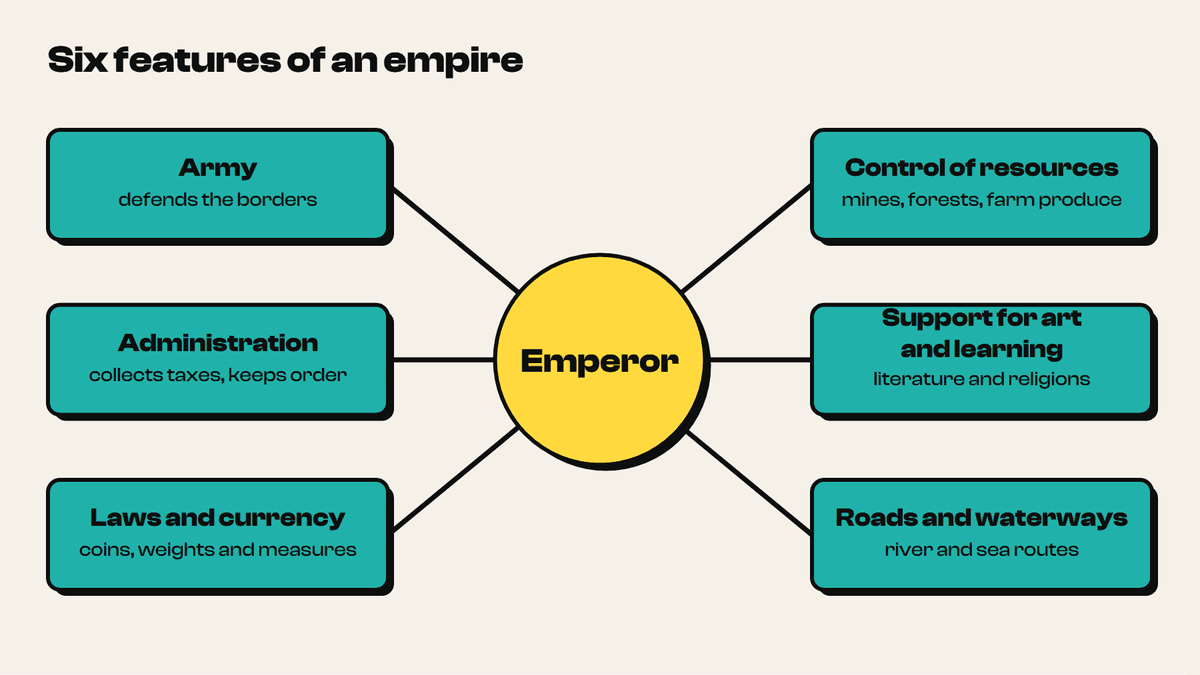
Most empires share six features. The emperor:
- keeps an army to control tributaries, win new land and defend the borders
- runs an administration whose officials collect taxes and keep order
- makes laws, issues coins and fixes weights and measures for trade
- controls resources such as mines, forests, farm produce and labour
- supports art, literature, religions and centres of learning
- maintains roads and river and sea routes for government, trade and people's welfare
Rulers wanted empires for several reasons: to be remembered by later generations, to gain power, and to control land, wealth and resources that made them stronger still. War was the most common method. A kingdom attacked and conquered its neighbours, then built forts at important places such as the frontier. Rulers also made alliances and tried to take control of rivers and trade networks, which brought valuable goods and tax income. Among many small kingdoms competing with each other, the one with the strongest army and the largest surplus of resources usually ended up as overlord.
9 more sections in this topic
Pick this up in your Library: it holds the whole topic, notes, cheatsheet and questions.