
Why a new world organization
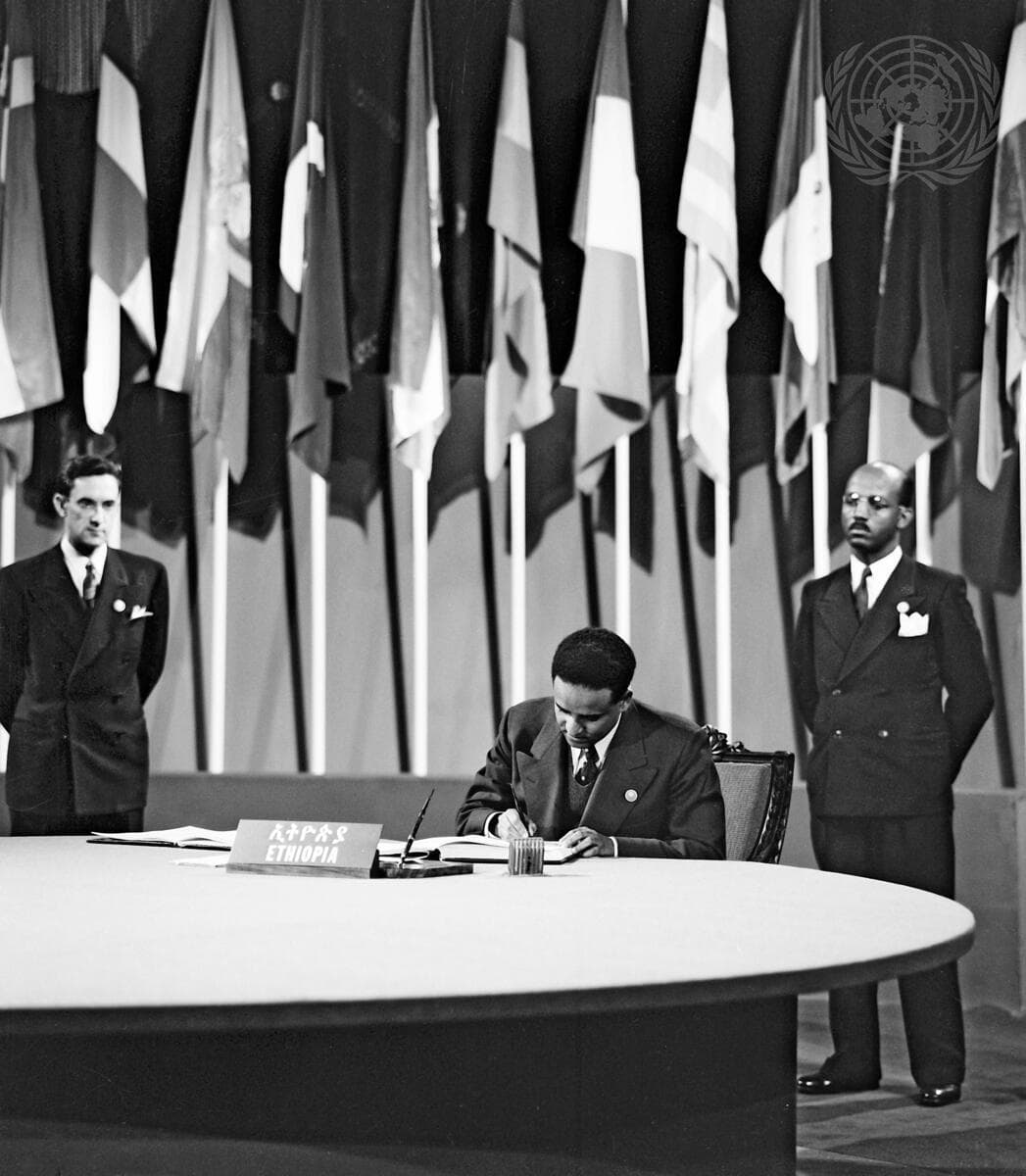
The United Nations (UN) was the second attempt in a single generation to build a world body that could stop war. The first attempt, the League of Nations, was set up after the First World War (1914–18) to prevent another general war. It failed. The League had been weakened by the absence of the USA, by having no army of its own, and by slow decisions backed only by economic sanctions. The Second World War that followed was the deadliest in human history, with more than 50 million people killed.
The victorious powers drew a direct lesson from this. They agreed to create a new and improved organization that would let the international community settle disputes before they turned into wars. Two changes from the League mattered most:
- Membership. Founding membership was open to the states at war with the Axis powers, and this time the most powerful states did join.
- The superpowers at the centre. The USA and the USSR both became members of the UN's most important body, the Security Council.
A body that sits above individual states. Members agree to cooperate through it and accept some loss of sovereignty (their freedom to act alone) in return for shared security.
The founders' own reasoning is clearest in Source G, President Harry Truman's speech to the opening session of the San Francisco conference in April 1945. Truman told the delegates that this was the most important and necessary conference ever held, and called them the architects of the better world. His argument ran in three steps:
- People who had lived through two world wars should understand how serious the problem was.
- Modern warfare was becoming more brutal and destructive and, if left unchecked, would eventually crush civilization.
- The only choice was between continuing international chaos and a world organization able to enforce peace.
When you use Source G, think about its origin and purpose. It is a speech by the US President to the delegates who had to agree a charter, so it is meant to persuade.
The word enforce is the key to it. Truman wanted a body with real power, which is exactly what the League had lacked.
The creation of the UN, 1941–45
The UN was planned while the Second World War was still being fought. Its design was agreed in stages over four years.
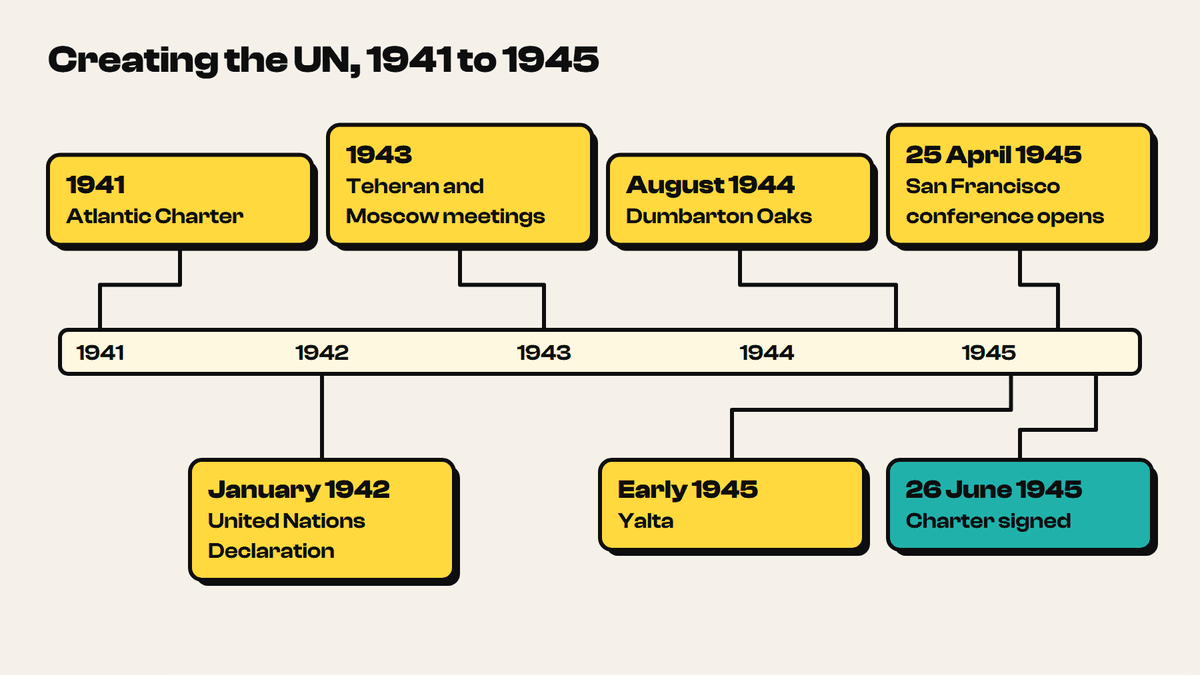
- 1941, the Atlantic Charter. British Prime Minister Winston Churchill and US President Franklin Roosevelt set out their aims for the post-war world. Both knew the League had failed and wanted any new body to be supported by all nations. The Charter restated the right of peoples to self-determination and signalled that a new peace organization would follow the war.
- January 1942, the United Nations Declaration. This confirmed the aims of the Atlantic Charter.
- 1943, Teheran and Moscow. Allied meetings decided to create a 'general organization' before the fighting ended.
- August 1944, Dumbarton Oaks. At this conference near Washington DC, diplomats from Britain, the USA, the USSR and China drafted the UN's structure. They agreed on a General Assembly and a Security Council, with some permanent members and others serving fixed terms.
- Early 1945, Yalta. The Allied leaders (Roosevelt, Churchill and Stalin) settled the dispute about voting. They agreed that the five permanent members of the Security Council (Britain, the USA, the USSR, China and France) would each have a veto, so any one of them could block a decision by voting 'No'.
- 25 April 1945, San Francisco. Delegates from 50 nations met to draft the charter. Agreeing the details took two months.
- 26 June 1945, signing. The UN Charter, with 111 articles setting out the UN's purposes and how it would work, was adopted on 25 June and formally signed the next day.
The right of a permanent member of the Security Council to block a resolution on its own by voting against it.
The veto was the price of getting every Great Power inside the organization. Source H, from the historian D. Yergin (1978), explains the Soviet side. The Russians remembered their troubles in the League, which had ended with their expulsion. They feared being isolated in a new body controlled by the USA and Britain through their allies, clients and dominions. They therefore accepted an American compromise. The Great Powers would keep a veto in the Security Council, and Western leaders would support the admission of two or three Soviet republics as members.
Source H shows that the veto was a deliberate design choice. The founders accepted that the UN could be blocked by one Great Power, because a UN without the USSR or the USA would repeat the League's mistake of leaving key states outside.
9 more sections in this topic
Pick this up in your Library: it holds the whole topic, notes, cheatsheet and questions.