
Global trade routes over time
By the late 1800s, goods, money and people were moving across the world along routes that had taken centuries to build. If you follow those routes in order, you can see who controlled trade at each stage and how that control changed hands, often through force.
Four stages stand out.
- Classical and medieval routes. Spices travelled by sea and over land between Asia, north-east Africa and Europe. The Silk Road linked China with the Mediterranean. Muslim traders dominated the sea routes for spices.
- European takeover from the 1400s. Portuguese, Spanish and later Dutch sailors pushed into the spice trade, and the USA joined in from the late 18th century, after independence.
- China and the West, 1790s–1860. Qing China restricted European trade and Britain pushed back. The dispute ended in the Opium Wars and a series of unequal treaties.
- The Atlantic slave trade, late 1400s to the 1800s. Europeans shipped millions of enslaved Africans to the Americas to work on plantations. Slavery lasted in the USA until 1865.
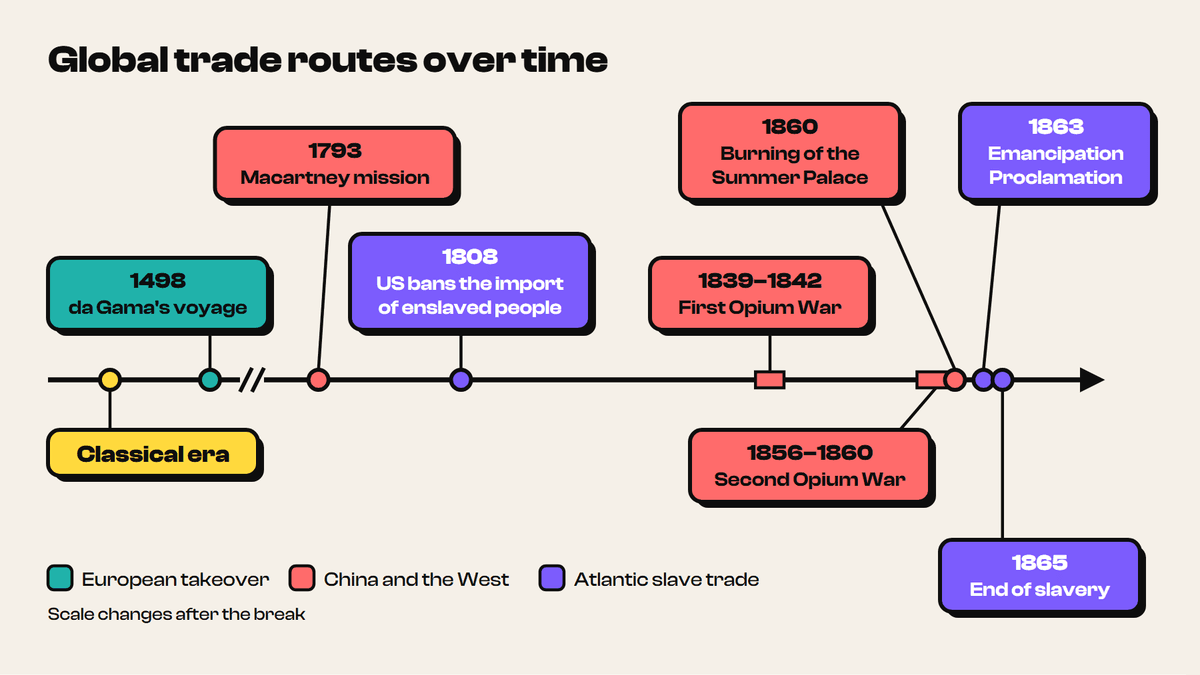
The same pattern appears in every stage. Trade was usually dominated by whichever power was economically strongest at the time. Highly profitable trades also tended to pull countries into rivalry and conflict. The way these routes spread religions, languages and foods belongs to the lesson on trade, aid, exchange and flows.
9 more sections in this topic
Pick this up in your Library: it holds the whole topic, notes, cheatsheet and questions.