
Causes of the Industrial Revolution in Britain
Two engravings of Leeds, a city in northern England, show how fast Britain changed. In 1750 Leeds was a small town with a church tower and a river, surrounded by open countryside. By 1850 the same view was packed with factories and smoking chimneys.
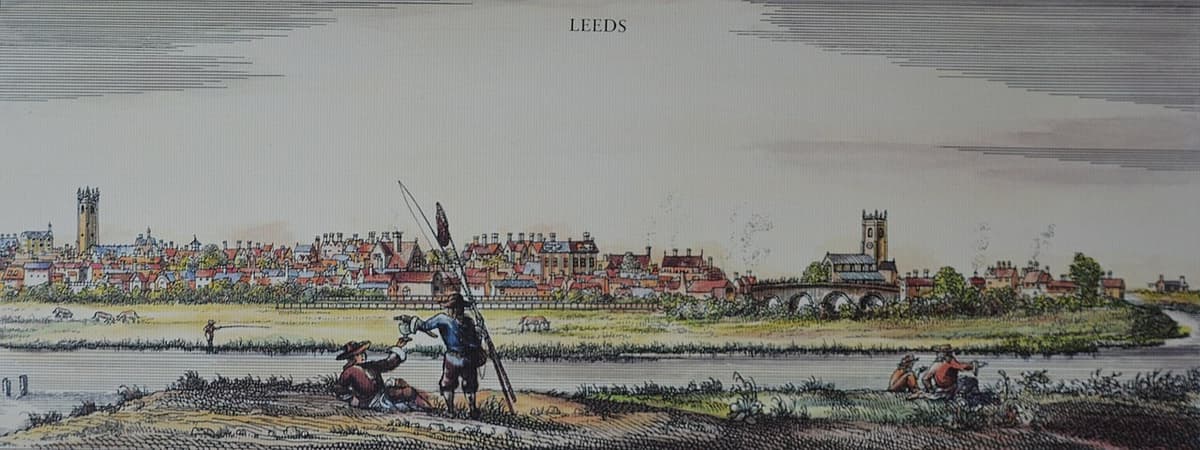
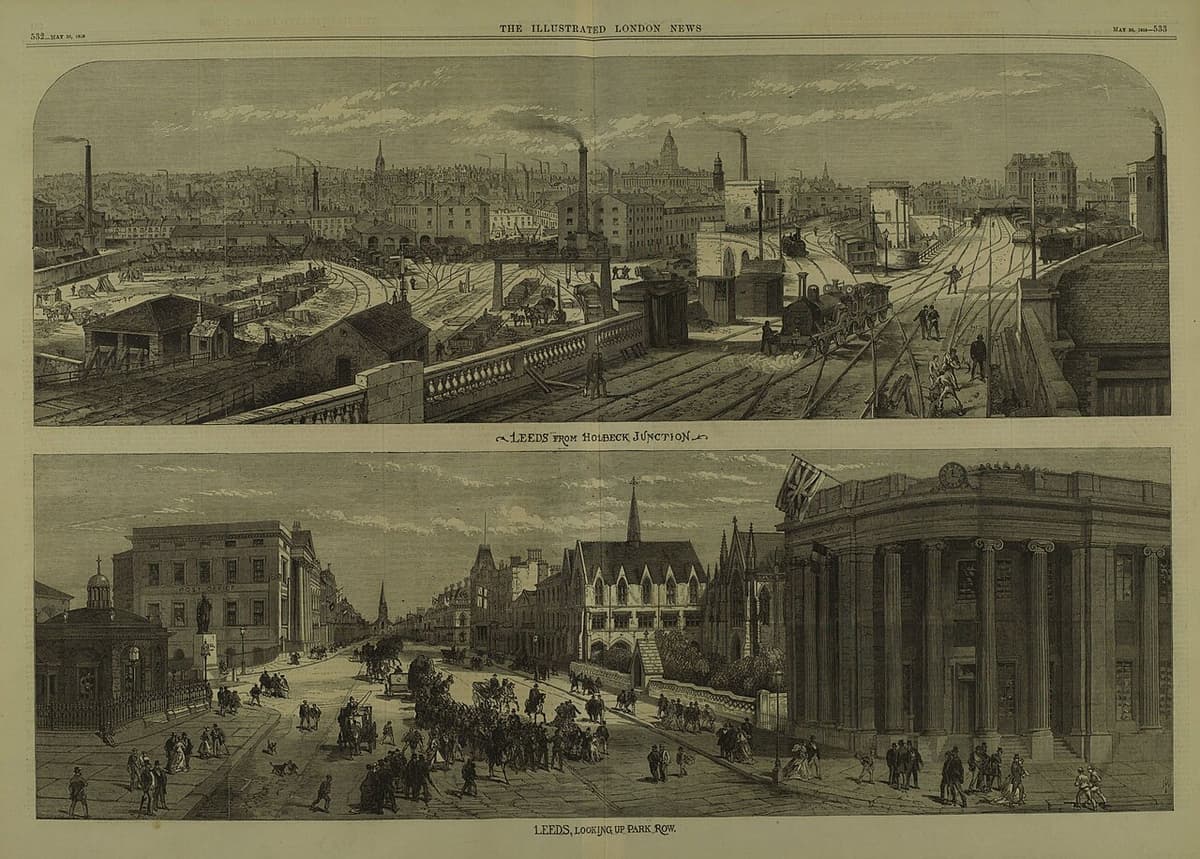
Between 1750 and 1850 Britain industrialized. Making goods moved out of homes and small workshops into factories full of powered machines. Historians call this period the Industrial Revolution. Before 1750 Britain had about 11 million people, and most of them lived in villages or small towns and earned a living from farming. By 1850 the population was about 21 million. Half of all people lived in cities, and more than 40 per cent of workers had factory jobs. Work, travel, living conditions and politics all changed as a result.
A territory controlled and settled by another country, which usually takes its resources and trades with it on its own terms.
Natural resources such as coal, iron ore or raw cotton that are used to make other things.
Products made from raw materials, often by machines in factories, such as cotton cloth, iron pots or pottery.
Britain was the first country in the world to industrialize. Historians point to several factors that came together there.
- Population. Britain's population began to rise from about 1740. More people wanted goods, and there were plenty of people available to work in factories.
- Overseas trade and colonies. By 1750 Britain held many colonies, which gave British merchants lots of chances to trade abroad. Many merchants grew rich and had money to invest in new businesses. The empire supplied raw materials and bought British goods. Raw cotton from India, for example, was made into cotton goods in Britain and then sold back to India.
- Agriculture. An earlier agricultural revolution meant farms produced more food. This fed the growing population, especially people in towns who could not grow their own. Farm workers also earned higher wages, so they could afford goods from the new industries.
- Transport. Between 1660 and 1750 better roads, improved rivers and new canals made moving things around Britain much easier. Coal and iron could be carried more cheaply, finished goods reached more customers, and letters, orders and new ideas travelled faster.
- Entrepreneurs and inventors. Britain had people willing to risk their money on new ventures, and a strong interest in science and technology. This led to many inventions in the textile and iron industries.
- Raw materials. Britain had plenty of iron for building machines and railways, and coal to fuel steam engines.
- Peace. Britain was politically stable and not at war, so business could grow and trade with the colonies could flourish.
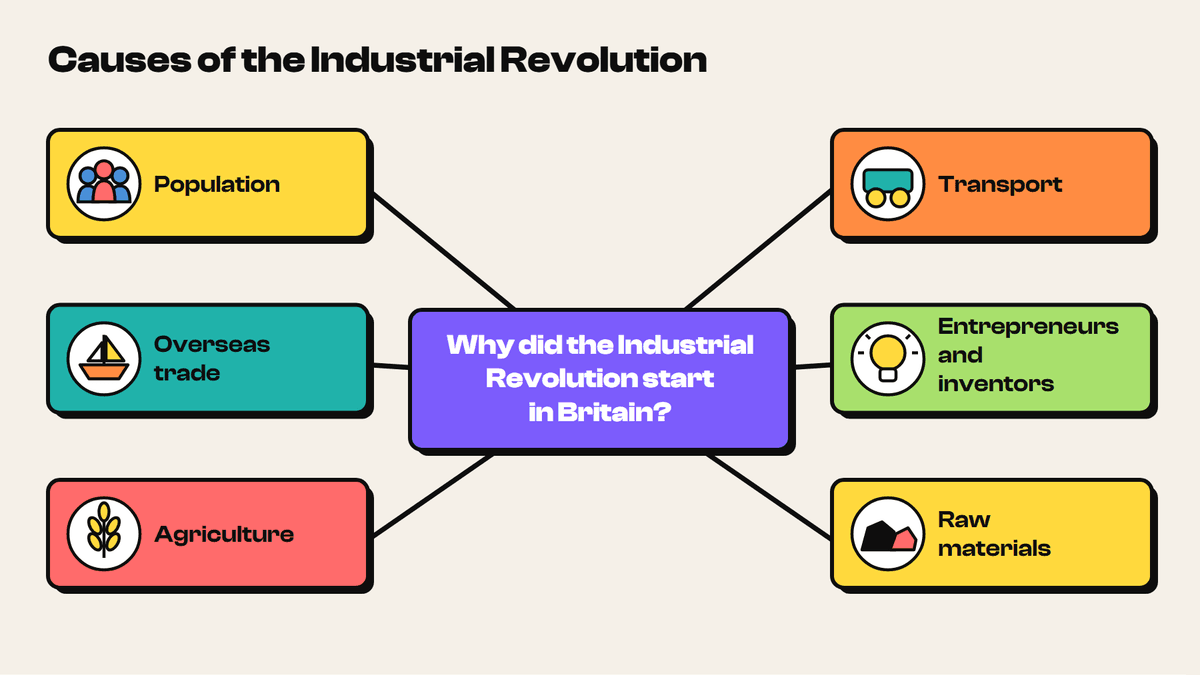
The factors worked together. A growing population raised demand for cloth, and higher farm wages gave people money to buy it.
Profits from colonial trade gave merchants money that entrepreneurs could invest in machines. Canals carried the coal and iron those machines needed. When you explain a cause, show how it connects to at least one other.
Textile inventions and the factory system
Textiles were the first industry to move into factories. After 1750 the fast-growing population needed far more goods, especially cloth, and the old way of making cloth could not keep up.
Turning raw cotton or wool into cloth took three main stages:
- Washing and carding. The fibres were cleaned, then combed so they lay in straight lines.
- Spinning. The fibres were twisted together into thread, also called yarn.
- Weaving. The yarn was woven into cloth.
A way of making goods in which workers, often whole families, spin and weave in their own homes. A merchant brings the raw materials and takes the finished cloth away to sell.
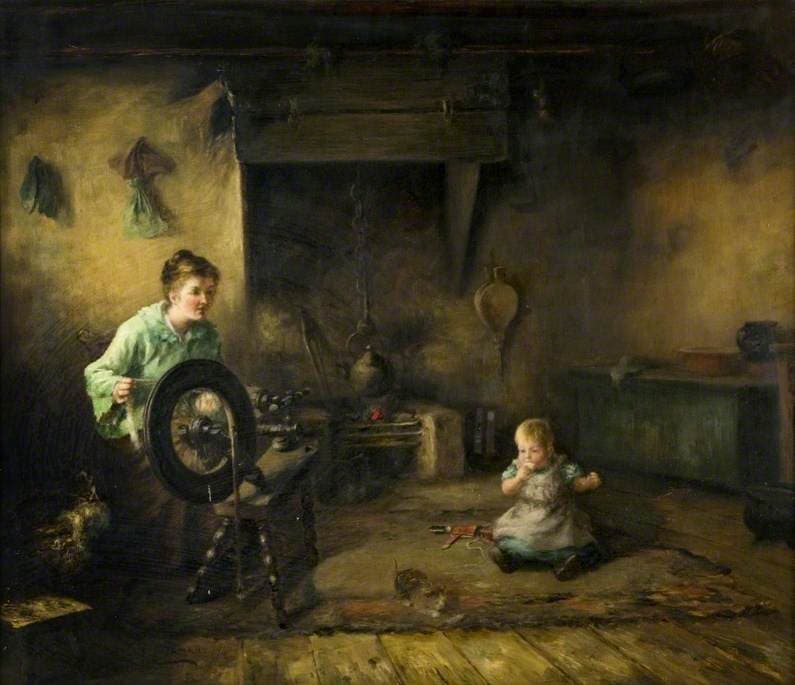
Under the domestic system, women usually did the spinning on a simple spinning wheel. Mothers, daughters and sometimes grandmothers worked side by side. The days could be long, but the workers chose their own hours. The yarn was then woven into cloth, either by someone else in the same house or at a weaver's cottage where the merchant had taken it. Finally the merchant carried the cloth to town and sold it.
The new machines arrived as a chain. Cloth-making had several stages, so speeding up one stage created a hold-up at another, and that hold-up pushed someone to invent the next machine.
- 1733, flying shuttle. John Kay's hand-powered device let one weaver make as much cloth as two had before. Weavers now used up yarn faster than hand-spinners could produce it, and yarn ran short.
- 1764, spinning jenny. Hargreaves's machine had 16 spindles but was small enough to use at home. By 1788 there were 20,000 in use.
- 1769, water-frame. Richard Arkwright, a wig-maker from Preston, built a spinning machine driven by water power. It was far too big for a house, so he built a mill to hold it at Cromford in Derbyshire. This was the first factory.
- 1779, mule. Samuel Crompton improved on Arkwright's machine. The mule spun much finer thread that was still strong, and it also had to be housed in a factory. With so much yarn available, weavers had plenty of work and good pay.
- 1785, power loom. Edmund Cartwright designed the power loom to speed up weaving and catch up with the spinning machines. It only worked efficiently and made good cloth from the 1820s. Once it did, it gradually put hand-loom weavers out of work.
Picture a line of people passing buckets of water. If one person suddenly passes twice as fast, buckets pile up at the next person until they find a quicker method too.
The flying shuttle sped up weaving, so spinning became the slow point. The jenny, water-frame and mule fixed spinning, and then weaving fell behind again until the power loom.
A way of making goods in which workers travel to a large building, a factory or mill, to operate powered machines for set hours under supervision.
Not everyone welcomed the machines. Kay met such anger from workers that he fled to France, and Hargreaves's home was set on fire. The power loom hit weavers hardest. Hand-loom weavers in Bolton earned 25 shillings a week in 1800 but only 5 shillings by the 1830s. Thousands lost their jobs and joined the unskilled poor looking for work in the new factories.
11 more sections in this topic
Pick this up in your Library: it holds the whole topic, notes, cheatsheet and questions.