
History of tourism
Picture a packed beach below high-rise hotels in Spain, a London shopping street full of visitors, a cruise ship anchored off a hilly coast and a diver swimming beside a sea turtle. All of these are tourism, yet they look very different. Tourism has taken many forms, and those forms have changed a great deal over the last few hundred years. Knowing how it changed helps explain why some places are crowded with visitors today and why new kinds of holiday keep appearing.
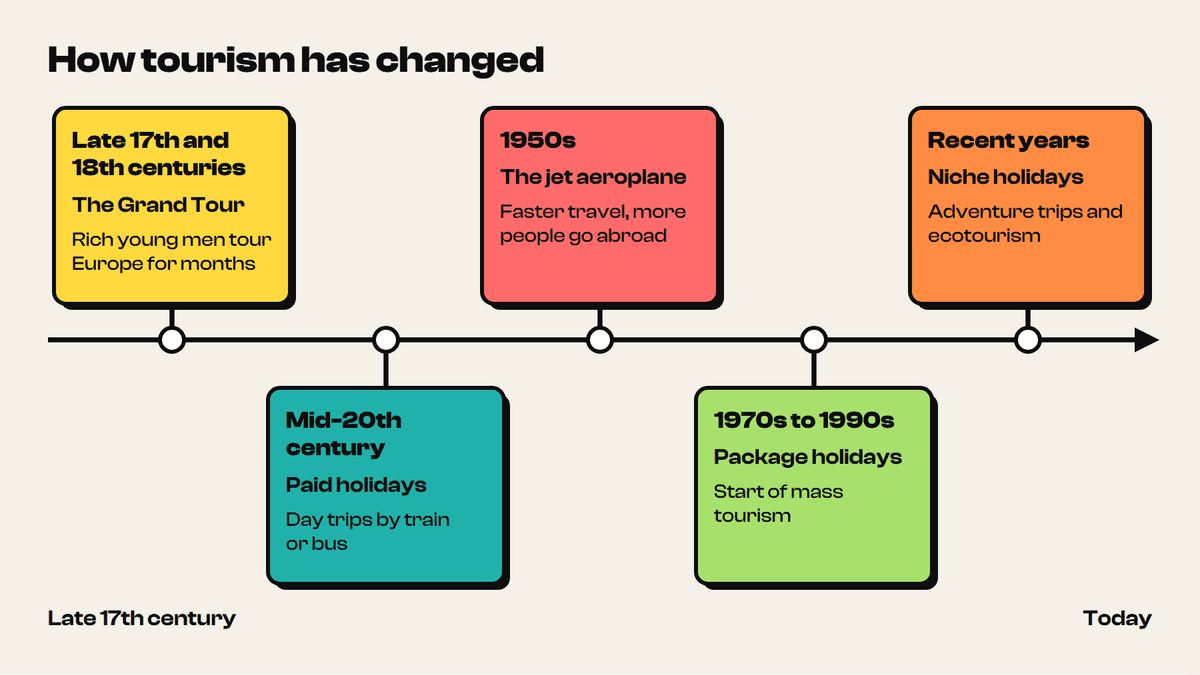
For most of history, holidays were only for the wealthy. The main stages of change are below.
- Late 17th and 18th centuries. Travel became fashionable among rich families. Young upper-class men spent several months touring Europe on the Grand Tour. A tour like this needed a private fortune and lots of free time.
- 19th century. Writers described journeys like these. Henry James wrote about them in Daisy Miller (1878), and Mary Shelley drew on her own travels. She came up with Frankenstein in June 1816, during a ghost-story contest with friends at the Villa Diodati by Lake Geneva in Switzerland.
- Mid-20th century. Some countries, especially in Europe, brought in paid holidays, so ordinary workers could take time off and still be paid. Most used it for day trips in their local area or their own country. Few owned a car, so they usually went by train or bus.
- 1950s. The jet aeroplane made travel much faster. More people went abroad to explore other places and cultures, but flying was still too expensive for many.
- 1970s to 1990s. Cheap package holidays started international mass tourism. Large hotels and airports were built in some regions, and specialist travel agents arranged everything. This was hugely popular in Europe.
- Recent years. Some places became overcrowded and people began to want more from a holiday. Niche holidays, such as adventure trips and ecotourism, have grown quickly.
A journey of several months around Europe made by wealthy young men in the late 17th and 18th centuries, to see famous places and cultures.
A holiday where the flight and the hotel are sold together as one product, usually for less than buying each part separately.
Large numbers of people visiting the same popular destinations, often on package holidays.
Some modern definitions of tourism leave out day trips, because the visitor does not stay overnight. Others count them. Check which definition a set of statistics uses before comparing it with another.
9 more sections in this topic
Pick this up in your Library: it holds the whole topic, notes, cheatsheet and questions.